
Title: Redox regulation of neuroinflammatory pathways contributes to damage in Alzheimer’s disease brain
Authors: Lauren N. Carnevale, Piu Banerjee, Xu Zhang, Jazmin Navarro, Charlene K Raspur, Parth Patel, Tomohiro Nakamura, Emily Schahrer, Henry Scott, Nhi Lang, Jolene K. Diedrich, Amanda J. Roberts, John R. Yates, III, Stuart A. Lipton
Year: 2026
Journal: Cell Chemical Biology
Doi: https://www.cell.com/cell-chemical-biology/fulltext/S2451-9456(26)00109-1
Our immune system often triggers inflammation in response to unknown external factors. In Alzheimer’s disease, this effect is mediated through the brain immune cells called microglia through multiple pathways. One such pathway involves a protein called “stimulator of interferon genes” (STING), which is located on the membrane of the endoplasmic reticulum. Upon activation of STING in response to inflammatory events, it rotates and associates itself with another STING molecule to form a dimer. The dimer is maintained in a stable active state by a disulfide bond between the two STING molecules. As long as the STING dimer remains active, it signals downstream to further mediate inflammatory signaling.
During inflammation, nitric oxide is often released in cells. NO covalently reacts with a cysteine amino acid of a protein to produce a nitrosylated form of the protein. (Figure 1A). This form is termed as a S-nitrosothiol adduct and it is referred to as SNO. In the STING protein, the disulfide bond is created due to the cysteine residue present at the position 148 (Cys 148). Carnevale et al. hypothesized that nitrosylation of STING at its cysteine residue might be responsible for the alteration in downstream inflammatory signaling pathways.
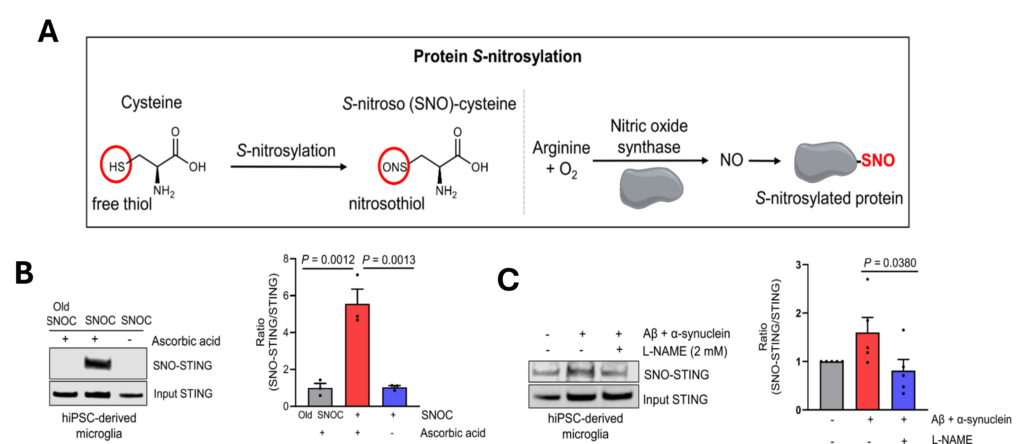
They had to determine if STING protein was nitrosylated in the first place. To do so, they used human post-mortem brains from Alzheimer’s disease patients, where they found that the STING protein was indeed nitrosylated, and there was an increase in downstream inflammatory complexes. To capture this effect in the lab, and further study the mechanisms involved, they opted for a stem-cell derived microglial model system where they noticed a similar trend. In response to nitric oxide release, amyloid beta or α-synuclein, STING protein was nitrosylated (Figure 1B,C), suggesting that these may contribute to immune signaling via S-nitrosylation of STING. Upon further investigation, scientists determined that replacement of the cysteine 148 with alanine resulted in loss of nitrosylation, suggesting that NO formed a bond with the thiol group in the cysteine 148 residue of the protein.
The next step in understanding the role of NO in STING mediated inflammation was to understand if NO produced in cells affected STING dimer formation. Through a series of experiments, they determined that the presence of nitric oxide does lead to dimer formation. The presence of inflammatory stimulants leads to an increase in nitric oxide production and the SNO-STING form and the dimer form of the STING protein. Further, when NO production is blocked, there is an absence of SNO-STING and the STING dimer, suggesting that NO stabilizes the transition state of the dimerization (Figure 2).

These results were also observed in Alzheimer’s mouse model systems, where they saw that with age, the proportion of nitrosylated STING was greater compared to unmodified STING protein in Alzheimer’s mice. They also observed that when the STING protein could not be nitrosylated, fewer microglia showed an indication of inflammation. In the brain, when microglia are inflamed, they often lead to neuronal loss since inflamed microglia tend to kill neurons. Hence, the authors assessed the neuronal numbers and found that the total number of neurons were higher when mice had the non-nitrosylatable STING protein.
The work done in this article is very extensive and highlights the fact that regardless of the protein expression, inflammatory pathways could be modulated due to modifications involving redox reactions. This paper presents a novel avenue for therapeutic targeting as it expands the possible mechanisms through which we can modulate protein function without modulating its expression. The study would require multiple follow ups including the effect of nitrosylation on pathogenesis of Alzheimer’s disease and effects of other modifications to the protein.

