Title: Swimming statistics of cargo-loaded single bacteria
Authors: P. Prakash, A. Z. Abdulla, V. Singh, M. Varma
Journal: Soft Matter
Year: 2020
Featured image adapted from an AI image generator source and Prakash et. al.
What if the next breakthrough in drug delivery does not come from a machine, but from a bacterium?
Bacteria are usually the villains in biology. We study them to kill them, control them, or stop them from causing disease. But in recent years, scientists have started looking at them a little differently, not just as microbes, but as tiny biological machines. They can swim, sense their surroundings, move through narrow spaces, and survive in environments where many synthetic systems fail. Naturally, this raises a fascinating question: can bacteria be used as microscopic cargo carriers?
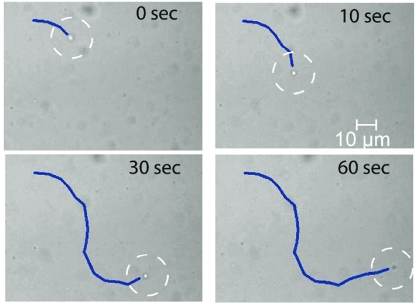
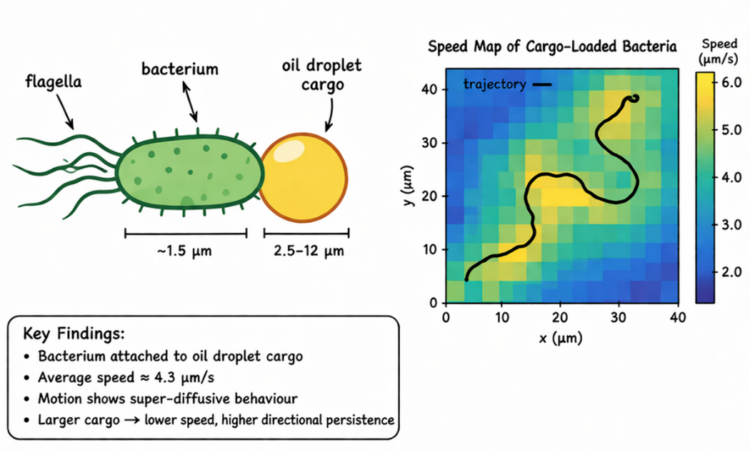
Researchers studied how a single bacterium behaves when it is forced to carry cargo, something that sounds simple until you realise how much physics is hidden in that sentence. If a bacterium is made to carry a load, does it still move properly? Does it slow down? Does it lose its ability to navigate? Or does it somehow adapt and keep going? To answer this, the team worked with Pseudomonas aeruginosa, a swimming bacterium equipped with flagella, the whip-like structures that help it move. Instead of attaching some complicated synthetic nanoparticle, they used oil droplets as cargo. Through a sonication-based method, they managed to get individual bacteria attached to oil droplets of varied sizes. To watch them move, the researchers used microscopy imaging, switching between fluorescence mode to confirm bacterial attachment and differential interference contrast (DIC) microscopy to record their swimming trajectories. Those videos were then tracked to calculate how fast the bacteria moved and how their paths changed over time and these were not just tiny decorations. Some droplets were actually much larger than the bacterial cell itself, reaching sizes of around 2.5 to 12 micrometres, while the bacterium was only about 1.5 micrometres long.
In other words, these bacteria were not just carrying a backpack. They were hauling something far bulkier than their own body.
The first obvious thing the researchers checked was speed. Unsurprisingly, cargo-loaded bacteria were slower. Free bacteria moved at around 15 to 23 µm/s, but once loaded with oil droplets, their average speed dropped to around 4.3 µm/s. So yes, the cargo made them slower, but not immobile. They still swam, and that is where things became interesting. Because while the bacteria slowed down, they also became more directionally persistent.
Normally, bacteria do not move in neat, straight paths. They follow what is often called a run-and-tumble pattern. They swim forward, pause or change orientation, then continue again. This makes their movement look random over time. But in this study, bacteria carrying oil droplets behaved differently. Instead of quickly becoming random swimmers, they showed super-diffusive motion, meaning they continued moving in a more directed way for much longer than free bacteria.
That sounds technical, but the idea is simple: they became slower, but also more committed to their direction. To study this, the authors used a parameter called mean squared displacement (MSD), which helps track how motion changes over time. Free bacteria showed the expected shift from more direct motion to more random movement. But cargo-loaded bacteria did not transition as quickly. Even after longer observation periods, they still showed stronger directional persistence.
So why would carrying a giant oil droplet make a bacterium more persistent? The answer lies in rotational drag. Once a bacterium is attached to a large droplet, it becomes harder for the whole system to turn. Think of it like trying to quickly change direction while dragging a heavy suitcase with one hand. You can still move, but sharp turns are no longer effortless. The cargo adds resistance, and that resistance makes the bacterium less likely to constantly reorient itself. As a result, it spends more time swimming in straighter paths.
The researchers also found that while cargo size clearly affected swimming speed, it did not show a strong, straightforward correlation on how much the bacteria changed direction. Bigger cargo made bacteria slower, but it did not automatically mean they would become less or more persistent in a predictable way. That suggests that bacterial navigation is not controlled by cargo size alone. Factors like how the droplet is attached and what the bacterium encounters in its surroundings also play a major role.
And this is where the paper becomes especially fun.
If the oil droplet attached itself neatly, the bacterium could continue swimming more or less forward. But if the droplet attached sideways, the motion changed dramatically. In those cases, the bacterium and its cargo could move in circular trajectories, because the forward push of the bacterium also caused the droplet to rotate. Instead of a neat straight swimmer, the system became mechanically biased into curving around. The paper even explains this using a physical model, showing how the geometry of attachment can completely reshape bacterial motion.
So this is not just a biology story. It is also a physics story. At the microscopic scale, motion is not intuitive. A bacterium carrying cargo is not just “a smaller version of a truck.” It follows a completely different set of physical rules. Viscosity matters more. Rotation matters more. Tiny asymmetries matter more. And this paper captures that beautifully by showing that even a single bacterium carrying a droplet becomes a surprisingly rich system to study.
Now, why should anyone care about bacteria towing oil droplets around? Because this connects directly to the growing field of bio-hybrid micro-robotics. Scientists are increasingly interested in designing tiny systems that can move through the body and its confined biological spaces to perform useful tasks, like targeted drug delivery and micro-scale transport. Bacteria are attractive candidates for this because they are already self-powered. They do not need batteries, motors, or external propulsion. They are already swimmers. If we can understand how they behave under load, we move one step closer to using them as programmable microscopic carriers. Of course, we are not at the point where your next medicine will arrive on the back of a bacterium. But this paper gives us something important: a better understanding of what happens when biology is turned into machinery.
And that, honestly, is what makes this work so interesting.
It takes something as ordinary as a bacterium and asks a very modern scientific question:
What happens when life itself becomes a tool? The answer, at least for now, is that bacteria can carry cargo, keep moving, and even do so with surprising persistence. They are slower, yes. Sometimes awkward, yes. But still functional. And maybe that is the most exciting part of all. The future of micro-robots may not be metallic or futuristic-looking. It may already be alive, swimming quietly under a microscope.