
Title: A pathology foundation model for cancer diagnosis and prognosis prediction.
Authors: Xiyue Wang, Junhan Zhao, Eliana Marostica, Wei Yuan, Jietian Jin, Jiayu Zhang, Ruijiang Li, Hongping Tang, Kanran Wang, Yu Li, Fang Wang, Yulong Peng, Junyou Zhu, Jing Zhang, Christopher R. Jackson, Jun Zhang, Deborah Dillon, Nancy U. Lin, Lynette Sholl, Thomas Denize, David Meredith, Keith L. Ligon, Sabina Signoretti, Shuji Ogino, Jeffrey A. Golden, MacLean P. Nasrallah, Xiao Han, Sen Yang & Kun-Hsing Yu.
Year: 2024
Detecting cancer early can save lives, but it’s not always easy. Even under the microscope, early tumors can hide in plain sight.
Histopathology, the microscopic examination of tissue samples, is the gold standard for cancer diagnosis. It provides critical information about tumor type, stage, and characteristics, forming the foundation for treatment planning. However, accurately detecting cancer at its earliest stages remains a significant challenge. Recent advances in artificial intelligence (AI) and machine learning (ML) offer a promising avenue for addressing the challenges. By leveraging large datasets of histopathology slides, AI systems can learn complex patterns that may not be apparent to human observers. Despite this potential, most existing AI models in pathology are constrained by the need for extensive, labor-intensive annotations or are limited in their ability to generalize across cancer types and imaging conditions.
To tackle these challenges, a group of researchers established the Clinical Histopathology Imaging Evaluation Foundation (CHIEF) model, an AI system trained to analyze digital pathology slides. Instead of focusing on just one cancer type, CHIEF was trained on large numbers of slides so it could learn general patterns of what cancer looks like across different tissues.
The Scientific Foundation Behind CHIEF
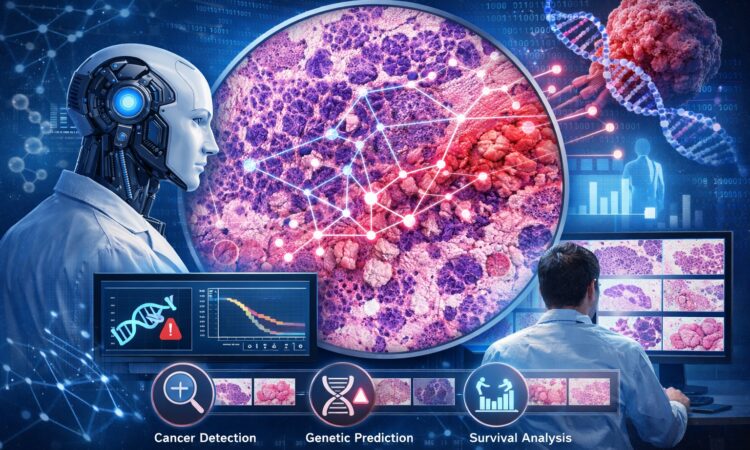
CHIEF is a pathology foundation model trained on over 60,000 whole-slide histopathology images across 19 anatomical sites and multiple cancer types (Figure 1). To handle these extremely large images, the model splits each slide into smaller sections and uses a transformer-based system to understand relationships between sections, capturing both local details and overall tissue structure. Unlike traditional AI approaches that rely on precise annotations marking the exact location of cancer, CHIEF is trained using only the overall diagnosis for each slide (e.g., cancerous vs. non-cancerous). This weakly supervised approach allows the model to learn broader structural and morphological patterns associated with malignancy, without needing labor-intensive, region-level labeling.
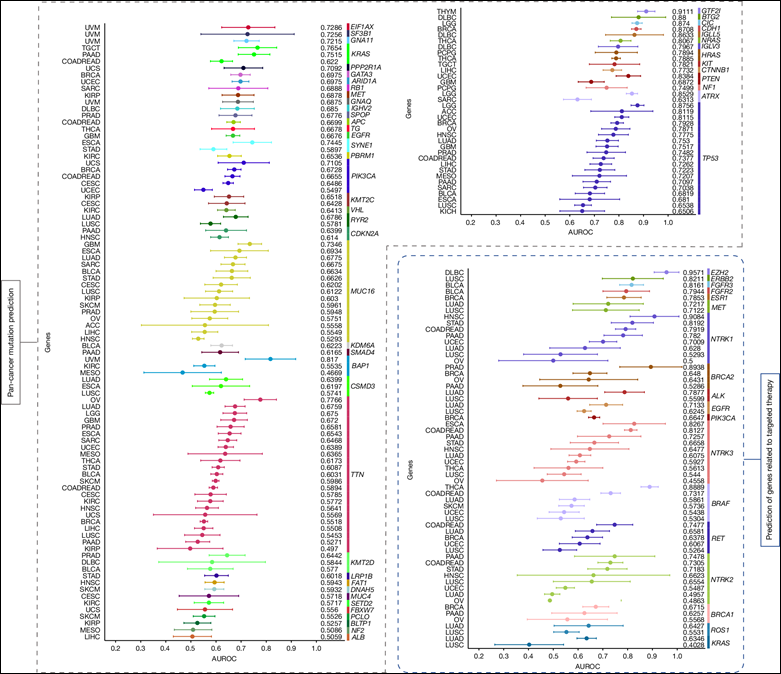
Another fascinating trait of the CHIEF model is that it predicts genetic mutations from histopathology slides across multiple cancer types. Each cancer–gene pair is evaluated using AUROC, which measures how well the model distinguishes tumors with a mutation from those without one. For example, in LUAD (lung adenocarcinoma), CHIEF achieves an AUROC of 0.67 for MUC16, meaning it can correctly rank a mutated tumor higher than a non-mutated one 67% of the time. Figure 2 highlights that CHIEF performs best for some genes (like TP53) across cancers, demonstrating its ability to infer genomic alterations directly from tissue images. Overall, it illustrates that histopathology alone contains predictive patterns of underlying mutations, potentially reducing the need for molecular testing.
In the study published in Nature, CHIEF was evaluated on multiple independent cohorts from 14 institutions, covering over 60,000 slides. It demonstrated strong performance in cancer subtype classification, survival prediction, and detection of molecular alterations, outperforming prior pathology AI models by up to 36% in cancer and genomic classification tasks and achieving an average 9% improvement in survival prediction across cohorts. Beyond detecting cancer, CHIEF can predict tumor type and origin, suggest potential genetic changes, and provide prognostic insights. By learning from overall slide diagnoses rather than detailed markings, CHIEF scales efficiently while providing a more comprehensive understanding of disease, answering not only “Is this cancer?” but also “What kind?” and “How serious?”
Clinical Impact
The introduction of CHIEF has profound implications for cancer diagnosis and patient care. By providing faster and more accurate analysis of histopathology slides, CHIEF empowers clinicians with actionable insights that can guide treatment decisions more effectively. Specifically, CHIEF enables personalized treatment, better prognoses, faster workflow, and consistent and reliable performance. CHIEF has been validated across multiple hospitals, imaging systems, and patient populations, ensuring its utility in diverse real-world settings.
Limitations and Future Directions
As the authors of the article conclude, despite its strong performance, CHIEF remains dependent on high-quality digital slide infrastructure. Prospective clinical validation is still needed to evaluate its real-world integration into pathology workflows. Moreover, regulatory considerations and model interpretability remain important challenges before widespread clinical adoption.
Reference
Wang, X., Zhao, J., Marostica, E. et al. A pathology foundation model for cancer diagnosis and prognosis prediction. Nature 634, 970–978 (2024). https://doi.org/10.1038/s41586-024-07894-z

