

Article Title: Metabolic cross-feeding of a dietary antioxidant enhances anaerobic energy metabolism by human gut bacteria
Authors: Zhou, Z.; Jiang. A.; Jiang, X.; Hatzios, S. K.
Journal: Cell Host Microbe
Year: 2025
DOI: 10.1016/j.chom.2025.07.008
The gastrointestinal tract contains trillions of microorganisms collectively known as the gut microbiome. These microbes perform chemical transformations on molecules within the body, contributing to physiological processes and overall health. Molecules can be host derived (e.g. from the diet) or produced by another neighboring bacterium. Here, Zhou et al. explore how two microbes co-break down a common dietary antioxidant, ergothioneine (EGT), to use it as fuel for energy in low-oxygen conditions.
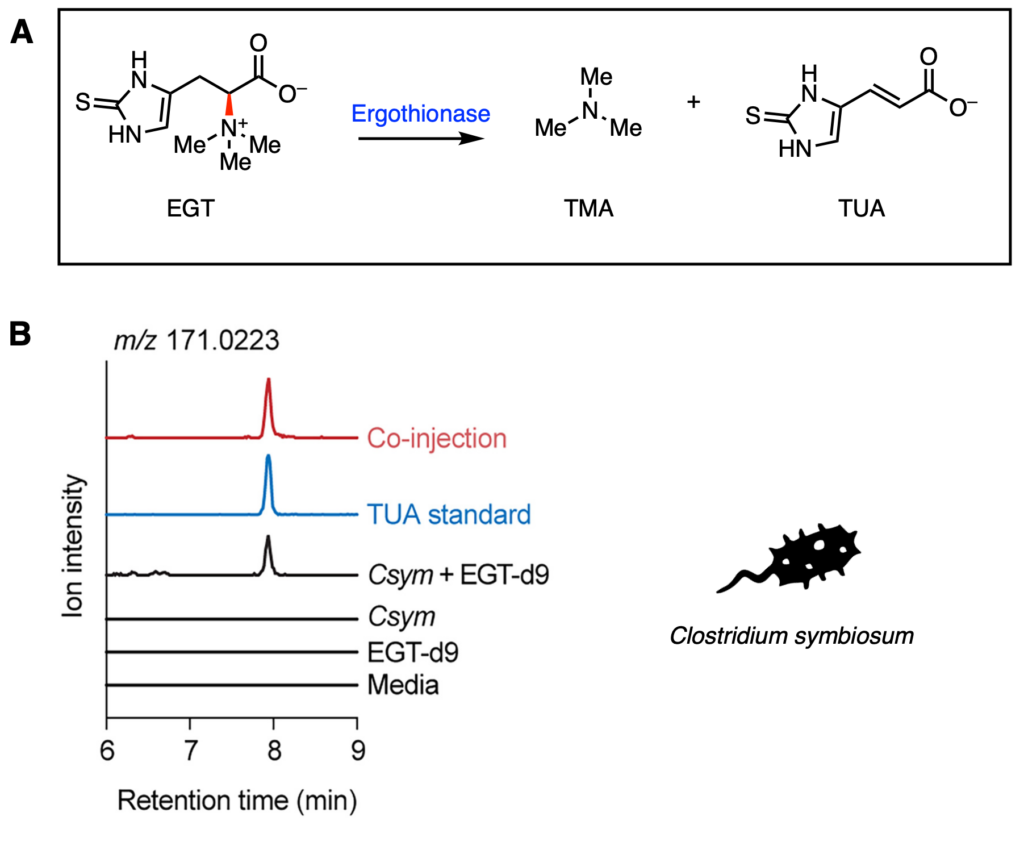
EGT is a natural compound found in certain foods, especially mushrooms, that helps protect our cells from damage. It works as an antioxidant, helping neutralize harmful molecules produced during normal metabolism and stress, and is present in the body at high concentrations. An oral bacterium called Treponema denticola SP33 can break down ergothioneine (EGT) using an enzyme known as ergothionase. This enzyme splits the molecule into two smaller compounds, trimethylamine (TMA) and thiourocanate (TUA) (Figure 1A). By examining the genomes (or DNA sequences) of gut microbes, researchers also identified Clostridium symbiosum as a bacterium capable of breaking down EGT into TUA. Indeed, when EGT was added to cultures of C. symbiosum, the authors detected production of a TUA, as compared to an authentic chemical standard (Figure 1B). Both peaks were detected at the same time and had the same chemical properties.
To determine whether this microbial activity occurs in a living host, the researchers tested whether mouse gut microbes could break down ergothioneine (EGT). They examined fecal samples from mice obtained from three different vendors—Charles River Laboratories (CR), Jackson Laboratory (JAX), and Taconic Biosciences (TAC). The ability to break down EGT varied widely: microbiomes from JAX mice showed no activity, CR mice showed very high activity, and TAC mice displayed moderate activity. Intriguingly, even though the authors could detect TMA production by the CR mice, they could not find any production of TUA! Since one of the co-products of ergothionase activity was detectable, the authors speculated that TUA was further metabolized into a different compound (Figure 2A).
By comparing metabolic profiles, the researchers identified a molecule that appeared at different levels in CR mice treated with EGT. Based on chemical reasoning, they proposed that a double bond in thiourocanate (TUA) was reduced to a single bond, forming a new compound called 3-(2-thione-imidazol-4-yl)propionate. To test this idea, they synthesized the proposed molecule and found that its properties (such as retention time and mass spectrometry profile) matched those of the previously unknown compound (Figure 2B).
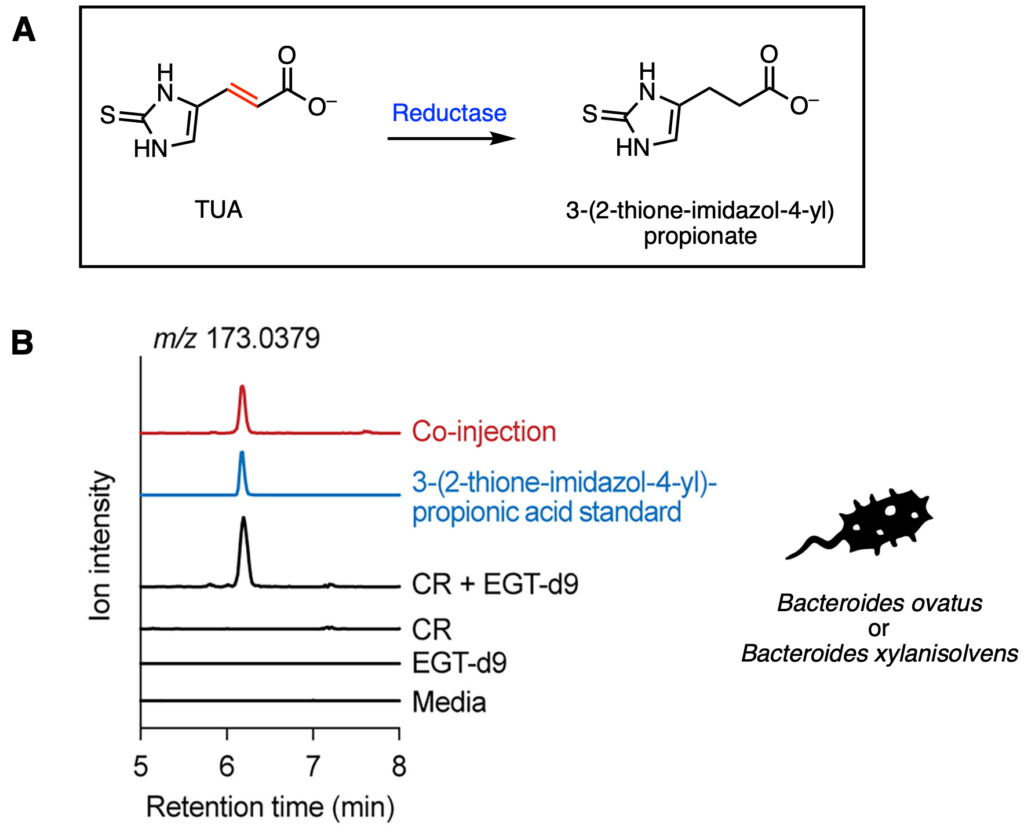
By examining which bacteria became more abundant in the presence of ergothioneine (EGT), the researchers suspected that members of the Bacteroides group might carry out this reduction reaction. Laboratory cultures confirmed that Bacteroides ovatus and Bacteroides xylanisolvens could convert TUA into the reduced compound. In addition, B. xylanisolvens was able to use TUA as its only terminal electron acceptor, suggesting that this reaction helps support energy production in oxygen-free conditions.

In this article, Zhou and coworkers investigated how bacteria in the human gut microbiome can co-metabolize a highly abundant dietary molecule (Figure 3). By understanding these interactions, scientists can better predict and classify all the unique chemical reactions that occur within the highly diverse gut microbiome.

