
Title: Synthesis of bacteriochlorophyll a
Authors: Duy T. M. Chung, Khiem Chau Nguyen, Yizhou Liu, Jonathan S. Lindsey
Journal: Chemical Science
Year: 2026
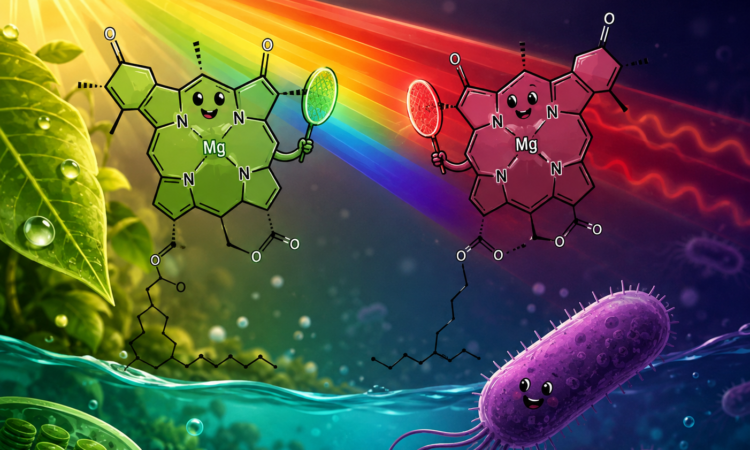
Featured image created using AI assistance and other figures created by adapting concepts discussed in Chung et al.
—
Every student has heard of chlorophyll; it is the green pigment that allows plants to capture sunlight and power photosynthesis. Without it, life on Earth would look very different. Interestingly, plants are not the only organisms that harvest sunlight.
Long before forests, flowers, and lawns appeared, photosynthetic bacteria were already converting light into usable energy. Instead of chlorophyll, many of these bacteria rely on a closely related pigment called bacteriochlorophyll a.
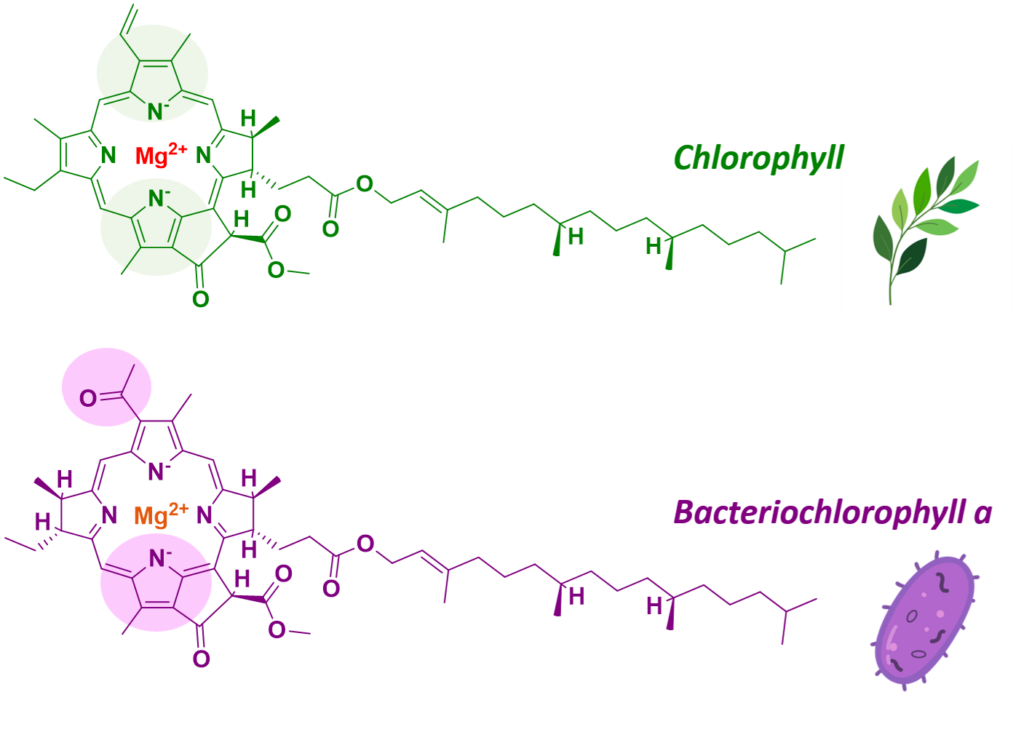
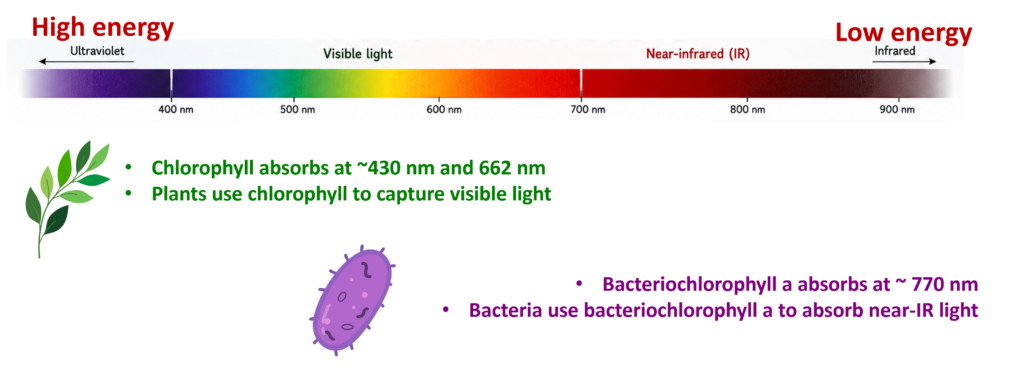
It performs a similar job, but with an interesting twist. While chlorophyll primarily absorbs visible light, bacteriochlorophyll a can absorb light in the near-infrared region, allowing bacteria to make use of wavelengths that plants largely ignore.
That ability has made bacteriochlorophyll a valuable far beyond the study of bacteria. Researchers interested in artificial photosynthesis, solar energy conversion, photomedicine, and light-harvesting materials have all been fascinated by this molecule. Yet despite decades of research, one problem remained unsolved. Nobody had ever completed a total synthesis of bacteriochlorophyll a. That might sound surprising. The molecule was first identified nearly a century ago. Surely, after all this time, someone must have figured out how to make it. Not quite.
Scientists could isolate bacteriochlorophyll a from photosynthetic bacteria. They could modify naturally extracted material and create simplified versions that reproduced some of its behavior. But building the complete molecule from simple chemical starting materials remained out of reach.
The obstacle was not due to a lack of effort; it was the molecule itself. Bacteriochlorophyll a is chemically intimidating. At its core lies a large ring-shaped structure known as a tetrapyrrole macrocycle, the same general family of structures that includes chlorophyll and hemoglobin. But bacteriochlorophyll a adds several extra layers of complexity.
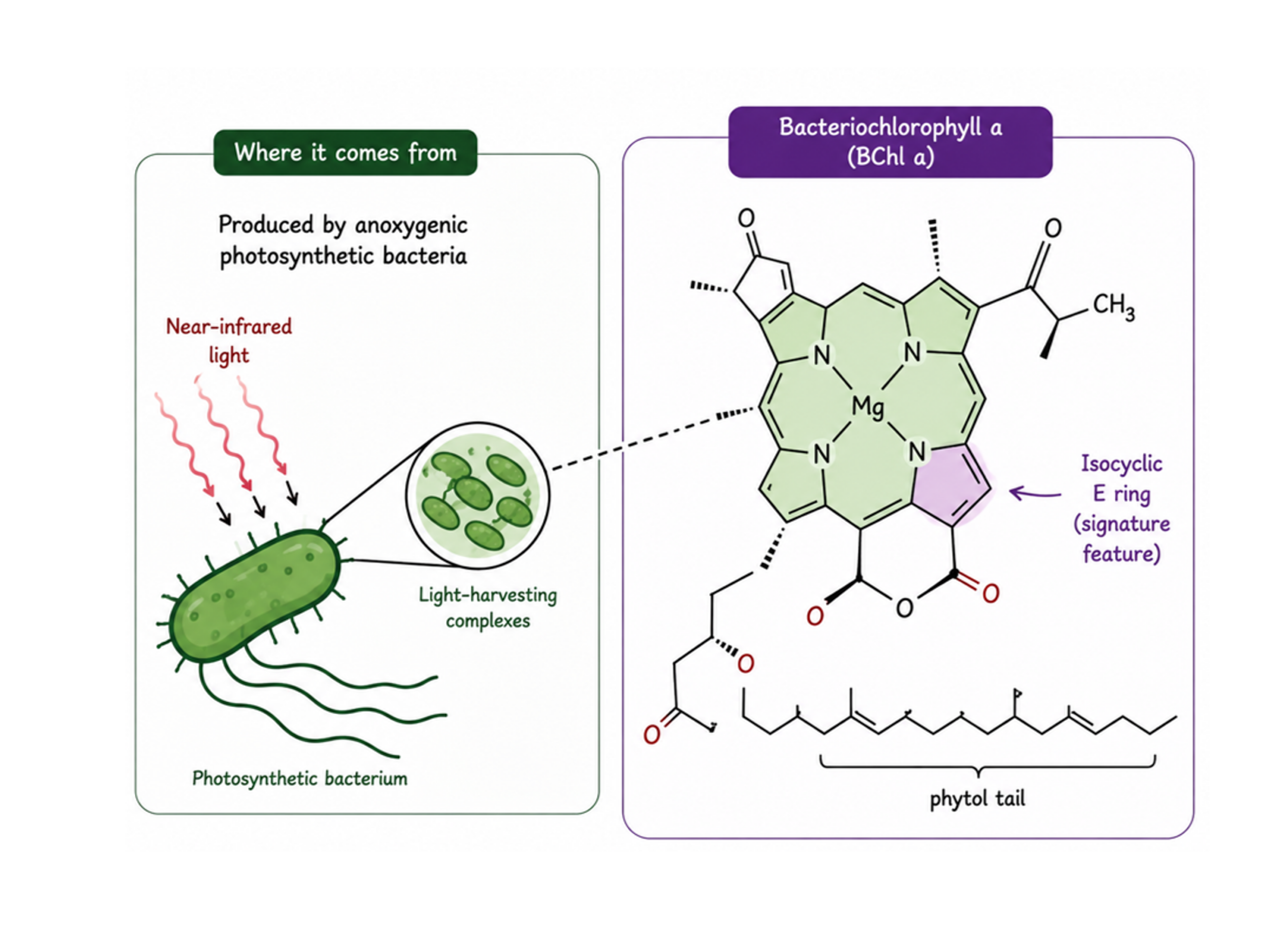
The molecule contains four stereocentre, locations where the three-dimensional arrangement of atoms matters enormously. By changing the orientation of just one of them, you end up with a different molecule. It also contains an additional ring known as the isocyclic E ring, a structural feature that has frustrated synthetic chemists for decades.
For years, these structural challenges kept bacteriochlorophyll a beyond the reach of total synthesis. The researchers behind this study approached the problem by breaking it into smaller, more manageable pieces. Rather than trying to construct the entire molecule in one heroic sequence, they divided it into two major fragments known as the AD half and the BC half. Each fragment could be built independently before being joined together later. The strategy feels a bit like assembling two sections of a thousand-piece puzzle separately before finally connecting them into a complete picture.
One of the most important decisions came at the very beginning of the synthesis. The team focused on establishing the correct stereochemistry early, before constructing the larger molecular framework. To do this, they used asymmetric Michael reactions, which allowed them to create the required three-dimensional arrangements from the outset.
This may not sound particularly exciting, but it saved the researchers from a synthetic nightmare. In complex molecule synthesis, discovering that a stereocentre is incorrect near the end of a multi-step route can mean starting over from scratch. Getting those details right early dramatically improves the chances of success later. Once these chiral building blocks were prepared, the researchers gradually transformed them into larger molecular fragments through a series of coupling and ring-forming reactions. Step by step, the AD and BC halves began to resemble pieces of the final pigment. Throughout this process, the team had to carefully preserve the stereochemical information established at the beginning while simultaneously increasing the structural complexity of the molecule. Each new reaction brought them closer to bacteriochlorophyll a but also created new opportunities for things to go wrong.
The real challenge arrived when it was time to connect the two halves. To accomplish this, the researchers used a Knoevenagel condensation, a reaction that linked the AD and BC fragments into a single larger structure. This was a major milestone, but the molecule was still incomplete.
The characteristic ring system that defines bacteriochlorophyll a had not yet fully emerged.
That problem was solved through a carefully designed sequence of ring-forming reactions. Among the most important was a Nazarov cyclization, which helped construct the crucial E ring while simultaneously shaping the growing framework into something much closer to the natural pigment.
This part of the synthesis is particularly elegant. The E ring was not simply attached as a finishing touch. Instead, it actively participated in building the larger molecular architecture. One of the most difficult features of the molecule became a tool for constructing another difficult feature.
Chemists love solutions like that. As the synthesis progressed, the researchers gradually assembled the complete macrocycle. Eventually they reached an intermediate known as bacteriopheophorbide a, which was then converted into bacteriopheophytin a. Only one crucial step remained.
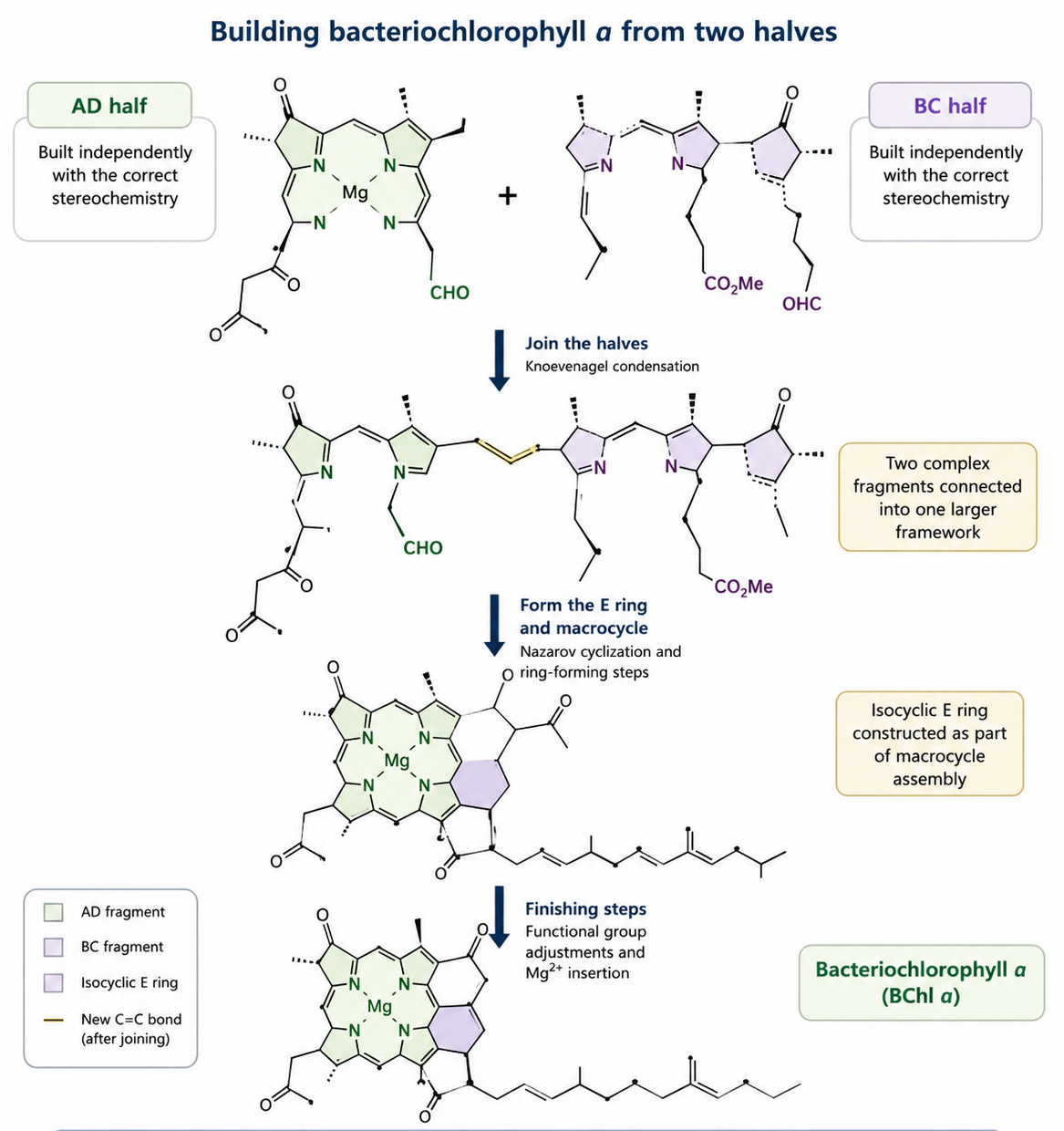
At the center of bacteriochlorophyll a, sits a magnesium ion. Without it, the molecule is not truly bacteriochlorophyll a. The researchers inserted magnesium into the macrocycle during the final stages of the synthesis, producing the target molecule and completing the first total synthesis of bacteriochlorophyll a from simple starting materials. Nearly a century after its discovery, chemists had finally learned how to build the molecule from scratch.
At this point, a reasonable question arises. Why spend years synthesizing a molecule that bacteria already make naturally? Because synthesis is about more than replication. When scientists can build a molecule from scratch, they gain control over it. They can modify specific positions, introduce isotopic labels, alter stereochemistry, and create entirely new variants that nature never produced. Those capabilities are incredibly valuable. Researchers interested in photosynthesis can use modified pigments to understand how biological light harvesting works. Materials scientists can explore new light-responsive systems. Chemists can investigate how subtle structural changes affect the behavior of the molecule. In some cases, entirely new applications may emerge. A useful comparison is the difference between owning a book and owning a printing press. Owning a book allows you to read it. Owning a printing press allows you to edit it, redesign it, translate it, and create entirely new versions.
For decades, scientists effectively had access only to nature’s copies of bacteriochlorophyll a. This synthesis provides the printing press. The significance of the work extends beyond a single molecule. Photosynthetic pigments are among the most important compounds on Earth. They capture solar energy, drive biological productivity, and support ecosystems across the planet. Yet surprisingly few of these molecules have been fully accessible through modern synthetic chemistry. Researchers hope that the strategy developed here will provide a roadmap for synthesizing other members of this family as well.
If successful, that could give researchers access to an entire collection of natural and modified photosynthetic pigments, opening new opportunities in chemistry, biology, materials science, and energy research. This research is not simply the story of one difficult synthesis. It is the story of gaining access to a family of molecules that have shaped life on Earth for billions of years. Chemists often celebrate the invention of new molecules. Sometimes, however, the real achievement is learning how to recreate one of nature’s oldest inventions.
Bacteriochlorophyll a has been quietly harvesting sunlight since long before humans existed. Now, chemists can make it too.

