

Title: Sailboat Measurements of Trace Gases in Urban Environments: In Toronto, Canada, Ground-Level NO2 Is Consistently Elevated over Lake Ontario versus at the Shoreline, but O3 Is Not
Author: James Donaldson
Year Published: 2026
Cover Image Credit: Dietmar Rabich, wikicommons
How clean is our air, both over the ground and over the water? That’s the question Dr. James Donaldson from the University of Toronto wanted to answer. In urban areas, air pollution often takes the form of ozone (O3) as well as nitrogen and oxygen compounds like nitrogen monoxide and nitrogen dioxide (NO and NO2). Commonly created by car engines or industrial processes, these compounds are associated with health conditions when they are present for people to breathe in high concentrations. Dr. Donaldson wanted to study if their concentration in Toronto changed over the water of lake Ontario relative to over land.
Collecting air quality measurements that are hyper-localized can be challenging. Donaldson addressed this by connecting a commercial air quality meter (the Aeroqual 500) to a sailboat. He first determined that the meter responded well to air pollutants over the land by comparing its results to the reported air quality measurements of large, stationary, air quality reporting stations. He also determined that it remained accurate when it was moving. He then attached the meter to the back of a sailboat and measured the amount of pollutant gases at different points of the lake near Toronto on 17 trips over three years.
Surprisingly, while the level of ozone was similar over the lake as on the ground, the level of nitrogen dioxide was consistently higher over the lake than on land. Donaldson reasoned that this is caused by the nitrogen dioxide-ozone cycle. These chemicals react with each other and with other gases in the atmosphere and the rate of these reactions determines their concentration in the air. They also can dissolve, albeit in small amounts, in the water and deposit on plants and surfaces on the land. When the sun is shining consistently in the late morning to early evening, the two gases achieve of photostationary state, a way of saying their concentrations stay fairly constant. This work found that the amount of each gas in the photostationary state was different over air and over water.
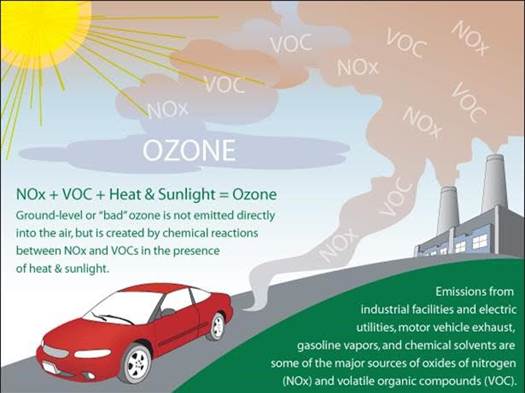
Image Credit: Ground Level Ozone Basics. EPA (Ground-level Ozone Basics | US EPA). Nitrogen containing pollutants (Nox interact with ozone and other pollutants in the atmosphere)
The paper hypothesized that while the amount of either gas absorbed by water is low and similar between each gas, the amount of each gas absorbed or deposited on land might not be equal. This could lead to the increased amount of nitrogen dioxide pollutant over the water.
The use of a sailboat allowed the pollution to be tracked on a hyper-local level. Instead of relaying entirely on a stationary monitoring station, pollution could be measured on land, on the lake, and towards both the east and west sides of the city. Collecting this data provides a reasonably economical way of gaining a much more fine tuned understanding of pollution.

