
Title : Discovery of Crystallizable Organic Semiconductors with Machine Learning
Authors: Holly M. Johnson, Filipp Gusev, Jordan T. Dull, Yejoon Seo, Rodney D. Priestley, Olexandr Isayev and Barry P. Rand
Journal: Journal of the American Chemical Society, 2024, 146, 21583–21590
Read the paper: 10.1021/jacs.4c05245
Featured image from unsplash.com
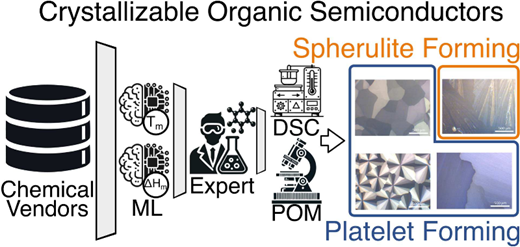
Figure 1. Image from the paper’s graphical abstract. Credit: Johnson et al.
Imagine being given some tiles to fit in a floor, for that not only the tiles matter, but also how they fit together with each other. Similar thing is applicable in the field of organic electronics where choosing the promising molecule is only part of the challenge. The way those molecules arrange themselves in thin film is the key factor how well the material works.
Organic semiconductors are carbon-based materials that can carry electrical charge. They are mainly used in technologies such as organic light-emitting diodes (OLEDs) and organic solar cells. Many organic semiconductor films used in devices lack long-range molecular order. Finding new molecules that form well-ordered films could help electrical charge move more easily, making these materials more useful for electronics. The researchers therefore sought molecules that could grow into broad, flat crystal regions. Identifying such candidates among thousands of possibilities usually requires considerable trial and error.
To tackle this problem, Holly Johnson from Princeton University and colleagues came out with a machine learning approach to screen commercially available molecules for laboratory testing. The interesting part of this study is how computer predictions and experimental knowledge worked side by side to get to the promising molecule candidate efficiently.
In an amorphous film, molecules lack a repeating arrangement over long distances. In a crystalline film, they form a more ordered pattern. This order can help electrical charge move through the material easily. These characteristics are similar to the difference between a neatly laid floor and one interrupted by gaps and uneven joins. However, molecular order is only part of the picture. The shape of the crystal regions and the conditions under which they grow also affect how useful a film will be in a device. These factors explain what the researchers looked for when selecting promising molecules.
The shape of the crystals matters too. The researchers sought platelets: broad, flat crystal regions with few boundaries that can interrupt charge movement. Another possible outcome is a spherulite, where many small crystal regions grow outward from a common starting point. These films can contain gaps and pinholes that create unwanted pathways for electrical current and reduce device reliability.
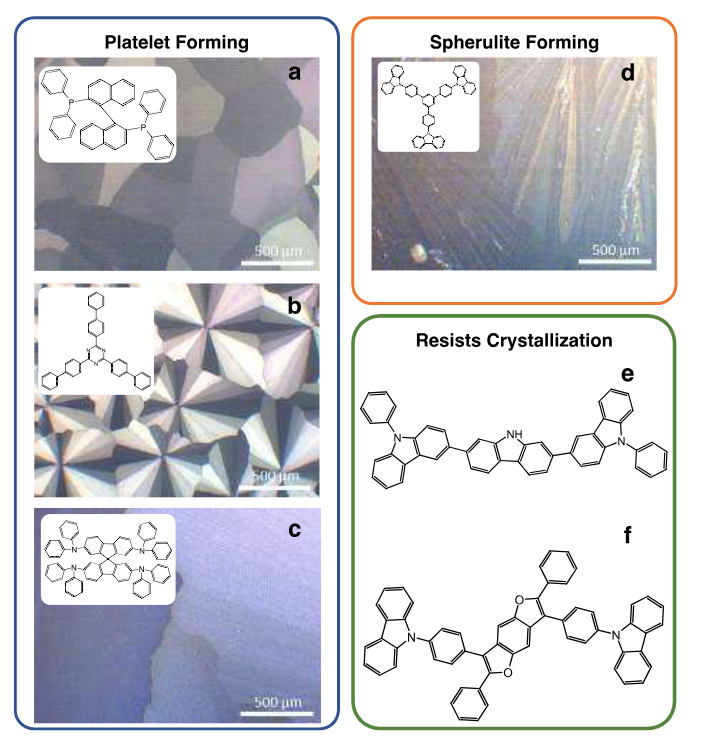
Figure 2. Different molecules produce different crystal patterns. rac-BINAP forms broad platelet regions (left), while TPB-Cz forms a needle-like spherulite (right). Credit:Johnson et al. (2024).
To grow these crystals, the researcher used thermal annealing which is heating an already deposited thin film so that its molecules can rearrange. The outcome mainly depends on the molecule and conditions such as film thickness, temperature and the surface. Heating every material in exactly the same way would not necessarily produce the same result.
The researchers first removed molecules that were unlikely to suit their experimental conditions based on their structures and experimental conditions before applying machine learning. They considered features such as molecular weight, rings and bonds that allow parts of a molecule to rotate. These filters reduced the starting collection from about 462,000 to 7,742 molecules. This filtering of the suitable molecules saved a great deal of experimental work.
Earlier experiments had pointed to two useful factors: melting point and crystallization driving force. The melting point tells us when a solid melts. The crystallization driving force tells us how energetically favourable crystal formation is at a given temperature. A more negative free-energy change means a stronger tendency to form a crystal. In this study, a high melting point combined with a strong crystallization driving force helped the researchers identify molecules likely to form platelets.
This is where machine learning came into the picture. In this study, researchers trained two machine learning models from existing measurements of melting point and the heat needed to melt a material, both based on Gradient Boosting Decision Trees (XGBoost). Each molecule was represented by numerical descriptions of its structure, called descriptors. By finding patterns linking these numbers to measured properties, the models could estimate properties for molecules that had not yet been tested.
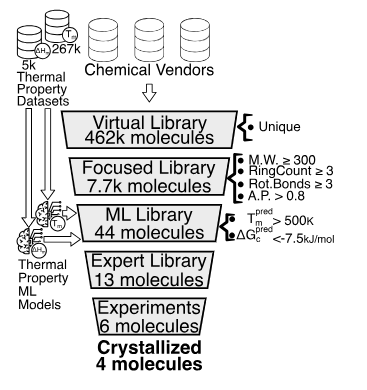
Figure 3. Overall machine learning screening where the search becomes smaller at each stage: about 462,000 molecules, then 7,742, 44, 13 and finally six for experiments. Credit: Johnson et al. (2024).
The thermal-property screening filtered 44 suitable candidates. Availability and price reduced this to 13, and the researchers then selected six molecules for suitable molecular structures and experimental requirements. The computer screening helped in shortlisting the suitable candidates but the chemists still decided what was practical to investigate.
The team then made thin films, adjusted the heating conditions and examined the results of the six screened molecules under a microscope. They also used differential scanning calorimetry, or DSC, which tracks heat absorbed or released as a sample is heated or cooled. This let them compare measured thermal properties with the machine learning predictions.
Out of the six molecules, four films crystallized, and three molecules formed platelets: rac-BINAP, TBT and spiro-TAD. Some spiro-TAD crystal regions reached millimetre dimensions, unusually large for the films studied here. TPB-Cz formed spherulites, while 9DT and CZBDF resisted thin-film crystallization under the conditions tested. The experiments tested a small shortlist selected with both machine learning and expert judgment.
There were also useful surprises. TBT formed platelets even though its measured thermal properties suggested otherwise. The researchers proposed that its ability to adopt different crystal arrangements, called polymorphism, might help explain this mismatch. Meanwhile, 9DT resisted crystallization in a thin film despite thermal measurements suggesting that crystallization was possible. These cases show that a few predicted properties cannot capture every detail of how a film grows.
The study offers a practical role for machine learning in chemistry, helping researchers choose which experiments to try first. Instead of making and testing thousands of films, the team used predictions to focus their effort, then let experiments reveal where the predictions worked to find the most suitable semiconductor candidate.

