
Paper: Radical-induced autoxidation dominates squalene oxidative aging under environmental conditions
Authors: Xinke Wang, Jillian P. Downey, Giulia Gobbi, William D. Fahy, Wanqi Wu, Linna Xie, Xingwang Hou, Hui Peng, and Jonathan P. D. Abbatt
Journal: Science Advances
DOI: https://doi.org/10.1126/sciadv.aei2144
When you touch surfaces indoors, you deposit skin oils on desks, clothing, floors, and furniture. These oils can remain long after you have moved away. The resulting thin films continue reacting with indoor oxidants, contributing to the complexity of indoor air chemistry.
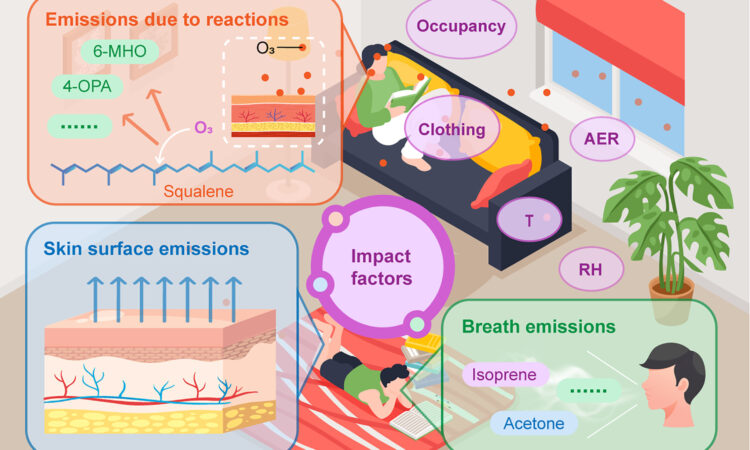
Front figure: Human-related indoor emissions from skin, breath, and ozone reactions with skin oils. AER, air exchange rate; T, temperature; RH, relative humidity. Reproduced from Jiang et al., Cell Reports Physical Science 6, 102962 (2025). https://doi.org/10.1016/j.xcrp.2025.102962. CC BY 4.0
Indoor and outdoor environments differ in the intensity and wavelengths of light available, which influence how oxidants form. At ground level, the UV component of sunlight consists mainly of UVA (315–400 nm), with a smaller contribution from UVB (280–315 nm). Outdoors, short-wavelength UV breaks down ozone to produce electronically excited oxygen atoms, which can then react with water vapour to form hydroxyl radicals (OH radicals). A radical contains an unpaired electron, making it highly reactive. Indoors, light is generally weaker and consists mainly of visible light (approximately 400–700 nm). Thus, OH radical generation through ozone photolysis is much more limited. Ozone entering from outdoors through ventilation and infiltration has therefore long been regarded as the main indoor oxidant.
Once ozone enters a building, its concentration usually decreases as it reacts with indoor surfaces and chemicals, particularly those containing C=C double bonds. Reactions between ozone and unsaturated organic compounds, including skin oils, can also generate OH radicals. Both ozone and OH radicals can therefore contribute to indoor oxidation despite the limited availability of short-wavelength UV light.
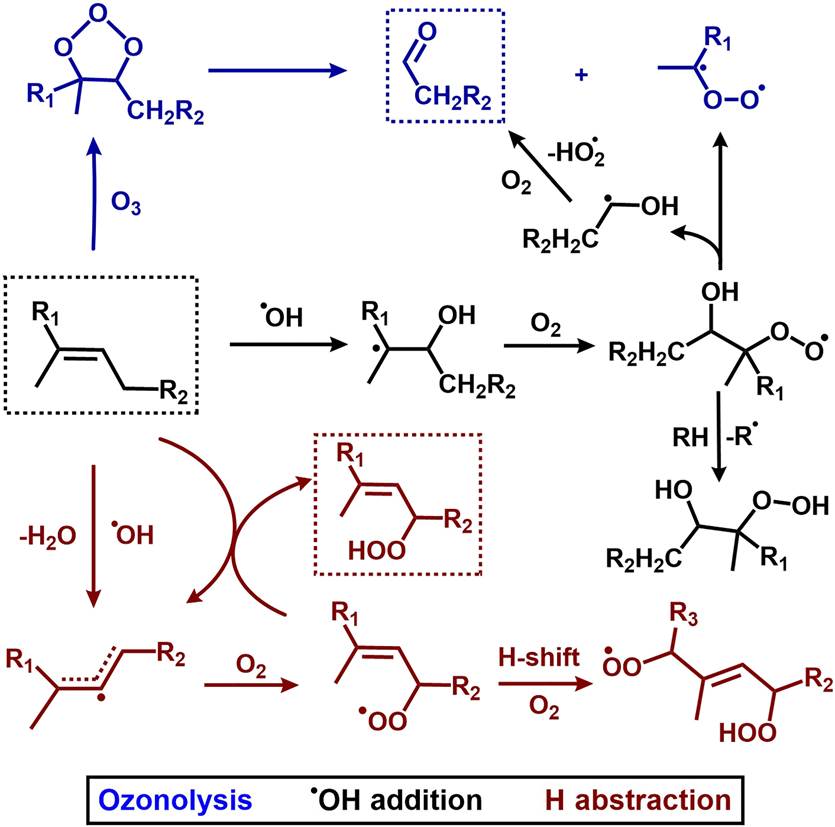
In their study, Wang et al. investigated the oxidation of squalene (Figure 1), an oily molecule that makes up about 10-12% of human sebum. Ozone can add across squalene’s six C=C double bonds without requiring light, forming unstable intermediates that can break the carbon chain into smaller fragments. This process is known as ozonolysis. Some fragments are volatile organic compounds (VOCs) that escape from the surface into the air.

OH radicals attack squalene differently. An OH radical can add to a double bond or remove a hydrogen atom, leaving an organic radical that rapidly combines with molecular oxygen to form a peroxy (ROO) radical. This process can initiate autoxidation, which is a radical chain reaction sustained by reactions with molecular oxygen. For example, a peroxy radical can remove a hydrogen atom from another organic molecule, forming an organic hydroperoxide, which contains an –OOH group, and a new organic radical. The new radical reacts with oxygen, continuing the chain. Repeated hydrogen-transfer and oxygen-addition steps can make the products increasingly oxygen-rich while retaining much of the carbon skeleton. The chain terminates when radicals are removed, for example by reacting with another radical. Autoxidation therefore does not require a fresh OH radical for every molecule transformed and can proceed without UV light.
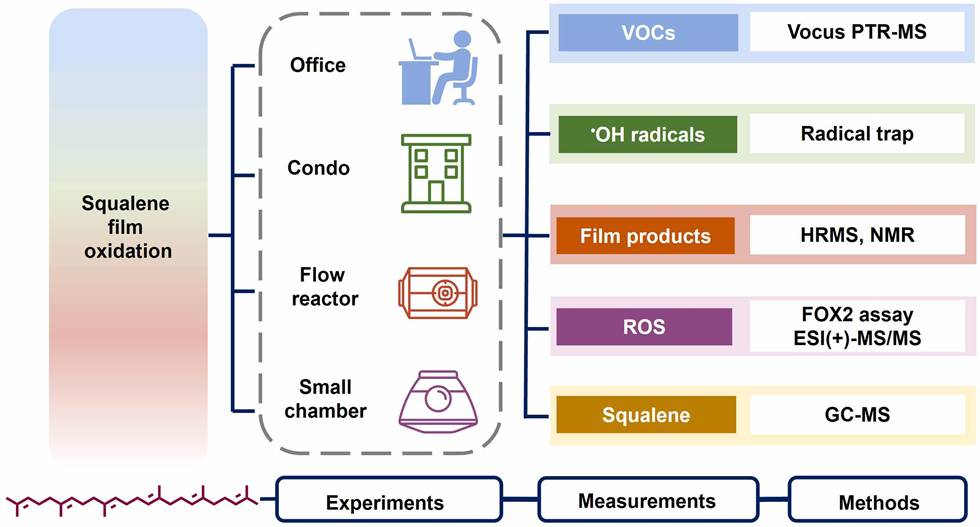
The researchers wanted to understand whether autoxidation initiated by OH radicals or ozonolysis is the dominant oxidation pathway for squalene indoors. They compared squalene aging in realistic indoor settings with oxidation in controlled laboratory flow reactors. They placed thin squalene films in a residential condominium and a dark office drawer. In the laboratory, they exposed films to either ozone alone or a combination of ozone and OH radicals. Across these settings, they measured how quickly squalene disappeared (Overview of their experimental techniques in Figure 3), which products accumulated in the films, how many VOCs entered the gas phase, and how many peroxide-like reactive oxygen species (ROS) formed.
Simple ozonolysis alone should produce approximately first-order decay under constant ozone exposure, as confirmed by the controlled lab experiments, with the loss rate slowing as less squalene remains. But in the condominium, squalene loss and ROS production accelerated after about ten days even though indoor ozone remained below 2 ppb. The accelerating pattern suggested autoxidation as reactive products accumulated within the film. In addition, ozone alone produced relatively low-oxygen products in the controlled experiment, but adding only about 0.12 ppt of OH radicals made squalene decayed faster, with more ROS formation and highly oxygenated organic hydroperoxides. The product pattern closely resembled the patterns from the office and condominium films.
Also, ozone favoured molecular fragmentation and VOC release. With ozone and OH radicals together, the number of measured VOC molecules formed per squalene molecule lost fell to about 0.06-0.07 (excluding acetone). The fraction of squalene-derived carbon released to the gas phase was only about 1-2%, compared with 14-20% across the reported ozone-only experiments. Rather than fragmenting into smaller VOCs, most of the oxidation products remained in the surface film as highly oxygenated hydroperoxides.
The researchers further investigated the transformation by moving an aged sample into a dark reactor without added oxidants. They found that the total ROS concentration changed by less than 5% over nine days, yet individual hydroperoxide products continued to rise. They also characterized the concentration of OH radicals in the film and found that the oxidized film can generate OH radicals internally. This observation shows that substantial oxidation can continue after the original squalene has been consumed.
These results highlight that indoor surfaces are active participants in the environments where we spend most of our time. Ozonolysis favours fragmentation and the release of VOCs into the gas phase, whereas OH-initiated autoxidation favours low-volatility compounds that remain in organic films. Measuring VOCs alone may therefore underestimate the oxidative burden associated with surface-bound products, which could contribute to human exposure through skin contact or the incidental ingestion of indoor dust and residues.

