Title: A shared alarmone–GTP switch controls persister formation in bacteria
Authors: Danny K. Fung, Jessica T. Barra, Jin Yang, Jeremy W. Schroeder, Fukang She, Megan Young, David Ying, David M. Stevenson, Daniel Amador-Noguez, Jue D. Wang
Journal: Nature Microbiology
Year: 2025
Featured image adapted from an AI image generator source and Fung et al.
We all know about bacterial infections and how bacteria can cause disease. Luckily, scientists have given us drugs called antibiotics to treat them. These drugs can kill bacteria or stop them from growing, helping our immune system clear the infection.
But what happens when almost all the bacteria die, while a tiny fraction simply refuses to be killed by the antibiotic?
It is not necessarily because those bacteria have become antibiotic-resistant. Antibiotic resistance involves genetic changes that allow bacteria to survive an antibiotic, while persistence is a temporary physiological state that allows individual cells to survive treatment. These cells are called persister cells.
Persister cells are still genetically susceptible to antibiotics. This means that if they return to their normal state, the same antibiotic can kill them. But while they are in the persister state, they become extremely difficult to eliminate. This makes persisters particularly interesting because they can survive antibiotic treatment and later grow again, giving rise to a new population of bacteria.
But here is the strange part. Scientists have known about persister cells for decades, yet it has not been completely clear how a bacterial cell decides to become one.
A new study looked at this question using Bacillus subtilis, a common soil bacterium. Unlike bacteria such as Staphylococcus aureus or E. coli, B. subtilis is not considered a major human pathogen, and infections caused by it are rare. However, it has occasionally been associated with infections such as bacteremia, meningitis, pneumonia, endocarditis, and wound and eye infections, particularly in people with underlying health conditions.
The researchers wanted to understand what happens inside a single bacterial cell just before it becomes a persister. To answer this question, they focused on a molecule called GTP.
If you have taken a biology class, you have probably already heard of ATP. Cells use ATP as one of their main energy currencies. GTP or guanosine triphosphate is another important molecule. It is involved in several essential processes inside the cell, including protein production, DNA replication, and ribosome assembly.
The researchers discovered that GTP levels can almost act like a molecular switch for persistence.
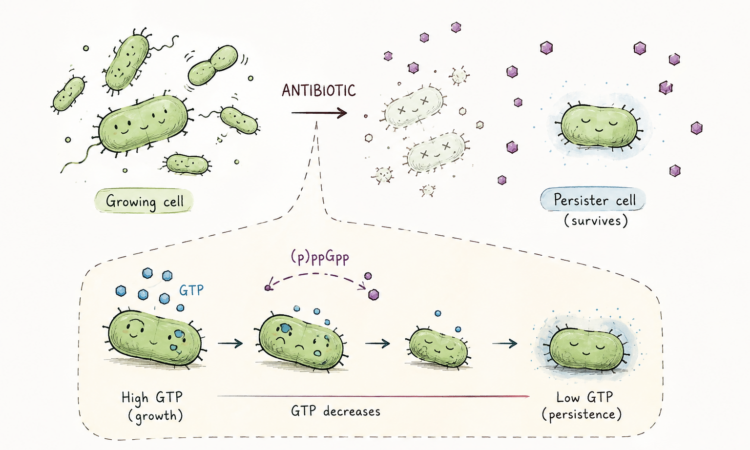
When GTP levels are high, bacteria continue growing and dividing. But when GTP levels fall below a certain point, the cell can rapidly switch from growth into a dormant state. Once it enters this state, it becomes extremely difficult for antibiotics to kill it.
So how does the cell know that its GTP level is falling? This scenario is where another molecule enters the story.
Bacteria produce a group of signalling molecules called (p)ppGpp, which include guanosine tetraphosphate (ppGpp) and guanosine pentaphosphate (pppGpp). Scientists often call these molecules “alarmones” because they are produced when bacteria experience stressful conditions such as starvation. They help the cell change its priorities when resources become limited. The researchers found that (p)ppGpp and GTP are almost like two sides of a seesaw.
When (p)ppGpp increases, GTP decreases.
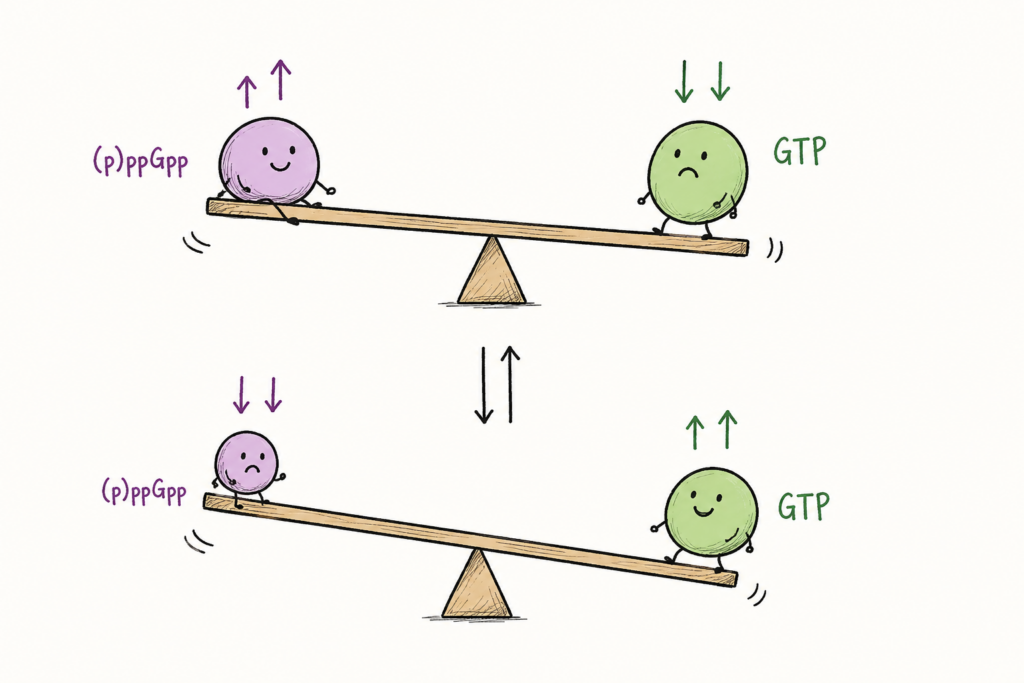
And when GTP falls far enough, the bacterial cell can enter the persister state. This raises an important question: Are persisters simply bacteria that are growing slowly?
It would be an easy explanation. Antibiotics often work better against actively growing bacteria, so perhaps the slowest-growing cells just happen to survive. But the researchers found that the story is more complicated.
They compared bacterial populations growing at different speeds and found that slower growth was strongly associated with antibiotic tolerance, but not necessarily with persistence. In other words, a population can become slower without producing more persister cells. They may look similar, but tolerance and persistence are not the same thing.
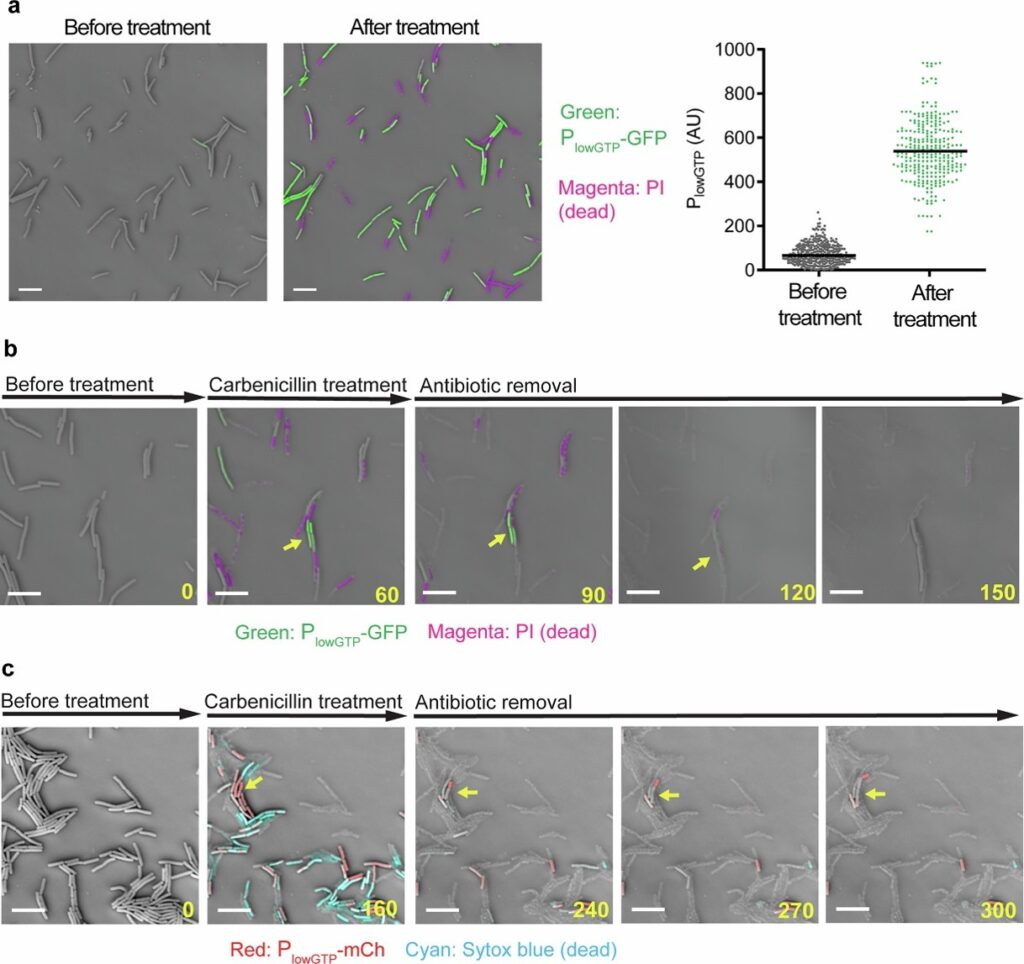
The researchers therefore needed to see what was happening inside individual bacterial cells. And this is where an important part of the study began. Instead of measuring the average GTP level across an entire population, they developed a fluorescent reporter that could reveal when GTP levels were low inside individual cells. When GTP became depleted, the reporter became brighter.
This allowed the researchers to look for rare cells inside an otherwise normal bacterial population that had unusually low GTP levels. Most cells were relatively dim. But a tiny group of cells lit up.
These bright cells turned out to be the persisters.
The researchers separated cells with high reporter fluorescence from the rest of the population and exposed them to vancomycin, an antibiotic. Around 80% of the low-GTP cells survived the treatment, compared with only about 0.1% of the cells with low reporter fluorescence. In other words, the cells with low GTP were overwhelmingly more likely to survive antibiotic treatment.
The researchers then used time-lapse microscopy to watch individual bacteria during antibiotic treatment. They could see that the cells behaving normally continued to elongate and divide before being rapidly killed. The cells with high reporter fluorescence, indicating low GTP levels, stopped growing and remained alive during the treatment.
But the researchers wanted to know something even more important. When does a normal bacterial cell actually become a persister?
To answer this, they followed around 30,000 bacterial growth and division events. Among all those cells, they found only about ten that spontaneously entered the persister state. At first, these cells looked completely normal. They continued growing and elongating just like the other bacteria around them. Then their fluorescent signal started increasing, showing that their GTP levels were falling. The cells continued growing for some time. Then, once the reporter reached a particular level, the cells suddenly stopped elongating. They had entered dormancy.
The order of these events was important. The GTP reporter changed before the cell stopped growing. This suggested that GTP depletion was not simply a result of the cell becoming dormant. Instead, the drop in GTP was helping trigger the transition into persistence.
The researchers found that this transition happened at a fairly consistent GTP threshold. They estimated that the switch occurred when intracellular GTP reached around 0.1 to 0.2 mM. So, the bacterial cell does not seem to gradually become a persister as its GTP level falls. Instead, there is a point where the cell crosses a threshold and rapidly changes its behaviour.
High GTP. Normal growth.
GTP falls. Growth stops. Persistence begins.
The researchers then wanted to know whether the same mechanism was responsible for different types of persister formation. Persisters can appear in several ways. Some are triggered by starvation. Some appear spontaneously even when the bacterial population is growing normally. Others can form after bacteria are exposed to antibiotics. The team found that these different pathways could converge on the same basic mechanism.
Different conditions caused the accumulation of (p)ppGpp. This then reduced GTP levels and increased the formation of persister cells. The exact enzymes involved could differ depending on how persistence was triggered, but the cells eventually reached the same low-GTP state.
The antibiotic experiments revealed another surprising part of the story. The researchers exposed B. subtilis to several antibiotics that target the bacterial cell wall, including vancomycin, carbenicillin, and bacitracin. These antibiotics caused some cells to accumulate alarmones and reduce their GTP levels.
A small number of these cells survived. When the antibiotic was removed, they were able to start growing again. The researchers also found that exposing bacteria to a lower, non-lethal concentration of bacitracin before a stronger antibiotic treatment increased the number of persisters that survived the later treatment. This response depended on SasA, an enzyme that produces the alarmone (p)ppGpp in response to stress. In other words, exposure to an antibiotic that was not strong enough to kill the bacteria could prepare some cells to survive a later, stronger antibiotic exposure.
This gives us a slightly different way of looking at antibiotic survival. We often think about antibiotic resistance as a genetic problem. A mutation gives a bacterium the ability to survive a particular antibiotic, and that trait can then be passed on to its descendants.
Persister cells are different.
The bacteria in this study were not genetically resistant. They had changed their physiological state. They stopped growing. They lowered their GTP levels. And they waited. Once the antibiotic was removed, they could return to normal growth. This may also help explain why eliminating an infection can sometimes be difficult even when the antibiotic is effective against the bacteria. Most of the population may be killed, but a small group of persister cells can remain behind.
And this is why understanding how persisters form matters.
If scientists can identify the molecular switch that allows bacteria to enter this protected state, they may eventually be able to target it. Instead of only trying to kill bacteria after they become persisters, future treatments could potentially prevent them from entering the state in the first place.
The study also shows why looking at individual bacterial cells can reveal things that are hidden when we only study a whole population.
So, how does a bacterium know when to hide? At least in Bacillus subtilis, part of the answer seems to be written in its GTP levels. When the levels fall far enough, the cell stops growing and waits for better conditions. The antibiotic may kill almost everything around it, but the persister survives. And when the antibiotic is removed, it can return to normal growth and rebuild the population.
What looks like a tiny fraction of bacteria simply “surviving” antibiotic treatment is actually a carefully regulated change in cellular state. A small shift in one molecule can determine whether a bacterium keeps growing or stops and waits. And understanding that switch may be the key to finding better ways to eliminate the cells that antibiotics leave behind.

