Title: Hydrophilic BIPHEPHOS Ligand for Pd-Mediated Cysteine Allylation of Peptides and Proteins in Water
Authors: Thomas Schlatzer, Julia Kriegesmann, Mark Bieber, Christian F. W. Becker, Rolf Breinbauer
In: Life Science Alliance, 2025
Link
A step-by-step overview of designing a water-compatible ligand for protein tagging
Have you ever looked at a complicated molecule and wondered who comes up with it? I remember thinking the same as an undergraduate. It all seemed quite mysterious at first.
In practice, chemists usually follow a structured approach. They start with a problem and then work backwards, designing or choosing a molecule that can solve it.
In the paper by Rolf Breinbauer and colleagues at the Technical University of Graz, the problem was this: how can we attach small chemical tags to proteins without damaging them?
Tagging a protein helps researchers track where it ends up in a cell, study how it behaves, or isolate it from a mixture for further analysis. In some cases, a tag can even give a protein a new function. But all of these tagging approaches only work when the protein stays folded and intact during the reaction.
Proteins, however, are sensitive and only remain stable under carefully controlled conditions. One thing they do not tolerate well is organic solvents such as acetonitrile or ethanol, which chemists often use to run reactions. When too much of these solvents is present, proteins begin to unfold or clump together, much like milk separating when it goes off. This is the starting point for the problem addressed in this paper.
Step 1: Define the Problem
To modify a protein without damaging it, the reaction needs to happen in water. The problem was that the reaction of interest only worked well when a large amount of acetonitrile was present. When the researchers tried to reduce the acetonitrile content and use more water instead, the reaction slowed down significantly.
This issue was linked to the catalyst, which is the component that speeds up the reaction. A catalyst usually consists of two parts: a metal and small helper molecules called ligands. The ligand binds to the metal, helps it do its job, and strongly influences how well the catalyst dissolves.
The original ligand, BIPHEPHOS-1, dissolved well in acetonitrile but poorly in water. When the mixture was mostly water, the ligand did not dissolve, the catalyst couldn’t form properly, and the reaction barely happened.
So, the problem was quite specific: the ligand needed to be redesigned so the catalyst would remain active and soluble in water.
Step 2: Design the New Molecule
The researchers looked at the structure of BIPHEPHOS-1 and asked a practical question: which part of the molecule can be changed to make it more water-friendly without altering its overall shape too much?
To answer this, they divided the molecule into smaller building blocks (Figure 1A). This is a common strategy in chemistry. It helps identify which parts of a molecule are essential for function and which parts can be modified. A look into the literature also showed which reactions were known to work on these positions and which changes other researchers might have already tried.
BIPHEPHOS-1 contains bulky tertiary-butyl groups (Figure 1B) that make it strongly hydrophobic, meaning the molecule prefers organic solvents and avoids water. Removing these groups entirely was not an option, because they also help define the shape of the ligand. So, the team looked for a replacement that was roughly the same size but interacted better with water.
After testing different possibilities, the researchers found that replacing the tertiary-butyl groups with diethyl phosphonate groups (shown in blue in Figure 1A) was a good compromise. These new groups take up similar space but mix more easily with water, making the whole molecule more soluble without changing its structure too drastically.
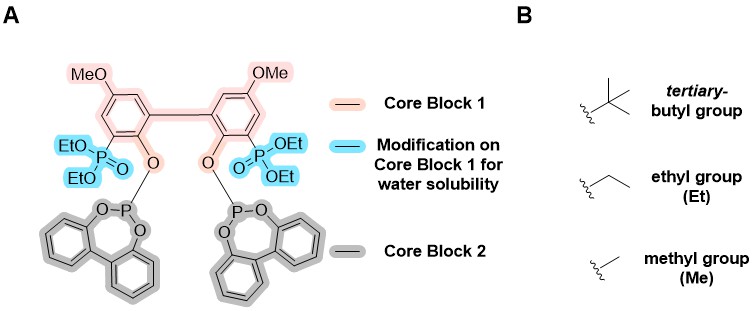
Figure 1: Simplified design of the modified ligand BIPHEPHOS-2. A: Chemists often divide a target molecule into smaller building blocks that can be bought or synthesised and then assembled. Here, the original BIPHEPHOS structure is shown in pink and grey, and the new water-friendly group is highlighted in blue. The drawing is simplified and does not show full stereochemistry. B: The original tertiary-butyl group, which does not mix well with water, is shown next to the new diethyl phosphonate group that replaces it. The ethyl (Et) and methyl (Me) groups used in A are also shown. Figure created by Corina Maller.
Step 3: Synthesize the Molecule
Once the design was set, the next step was to make the new ligand in the lab. The synthesis started from Core Block 1 (Figure 1A), with the remaining parts added step by step.
Introducing the diethyl phosphonate groups (shown in blue in Figure 1A) was the key step. This part of the synthesis did not work properly at first. Some reaction conditions led to unwanted byproducts, while others produced only small amounts of material. To overcome this, the researchers tested several different reaction setups.
Once these steps were optimised, they were able to isolate the new ligand, BIPHEPHOS-2 (Figure 1A).
Step 4: Analyse and Scale Up
After the synthesis, the first question was: did we actually make the right molecule? The researchers checked the structure and purity of BIPHEPHOS-2 using standard lab methods that confirm which atoms are present and how they are connected. These checks ensure that there are no unwanted byproducts and that the molecule matches the intended design.
Once the ligand was confirmed to be correct and pure, they produced a larger batch. Scaling up is a common step in chemistry. It provides enough material for further experiments and shows that the synthesis works reliably beyond a small test scale.
Step 5: Test the Molecule in Reactions
With BIPHEPHOS-2 in hand, the researchers tested the reaction in mostly water. They checked whether the catalyst (palladium bound to the ligand BIPHEPHOS-2, Figure 2) remained active and dissolved, whether the proteins stayed folded, and how efficiently the chemical tags were attached. The results were promising. The catalyst remained active in mostly water, stayed dissolved, the proteins remained folded, and the reaction proceeded quickly. BIPHEPHOS-2 worked just as well as, or better than, the original BIPHEPHOS-1, even when the reaction mixture contained only about 5% acetonitrile and 95% water.
For the first time, the team had a ligand that enabled gentle, protein-friendly tagging in conditions that closely resemble the natural environment of proteins (Figure 2).
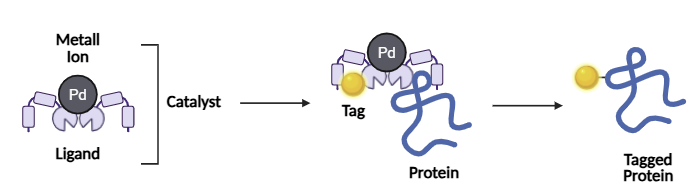
Figure 2: Catalytic Tagging of Proteins. This schematic shows how the new ligand, BIPHEPHOS-2, helps the palladium catalyst attach a chemical tag to a protein. The ligand guides the catalyst, bringing the protein and tag close together so the reaction can occur efficiently. The result is a tagged protein that remains folded and functional. Figure designed by Corina Maller and created with BioRender.com.
(If this step had failed, the process would have looped back to Step 2 to redesign the ligand. In this case, everything worked as planned.)
Takeaway
Designing new molecules is rarely guesswork. It is a stepwise, problem-focused process that involves defining a challenge, adjusting molecular structures carefully, testing, analysing, and refining. In this work by Rolf Breinbauer and colleagues, a small but thoughtful modification transformed a water-incompatible ligand into a practical tool to help modify proteins under mild conditions.
Together, these results show how careful molecular design can bridge the gap between chemical reactivity and biological compatibility, allowing proteins to be studied and modified without disrupting their structure.

