
Title: Our Best Friends: How Dogs Alter Indoor Air Quality
Authors: Shen Yang, Nijing Wang, Tatjana Arnoldi-Meadows, Gabriel Bekö, Meixia Zhang, Marouane Merizak, Pawel Wargocki, Jonathan Williams, Martin Täubel, and Dusan Licina
Year Published: 2026
Journal: Environmental Science & Technology
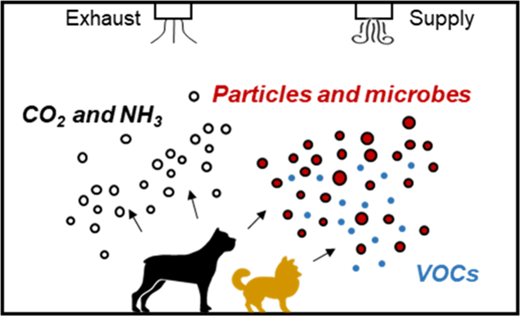
Dogs do not just share our homes; they share the air we breathe. More than just emotional support, dogs may also shape the air around us. Some studies suggest that early-life exposure to dog-associated microbes may lower the risk of asthma or allergies in children. Meanwhile, some people feel indoor air quality worsens around pets. Despite the mixed and complicated impacts of dogs on health that many researchers are still trying to understand, we first need to know what dogs actually add to indoor air, a question that remains surprisingly underexplored.
In recent years, humans have been identified as major sources of indoor air pollutants. We release volatile organic compounds (VOCs), aerosols, and microbes through breath, skin, and activities such as cleaning and cooking, while also carrying outdoor pollutants indoors. Human skin can also act as a reactive surface. Squalene, the main human skin oil component, contains six double bonds, making it susceptible to oxidation by ozone, a common indoor and outdoor air pollutant. When ozone reacts with squalene, it can produce various VOCs and tiny particles such as nanocluster aerosols (NCAs), enriching indoor air chemistry. Dogs share some physiological similarities with humans as mammals, but their skin oils are composed mainly of cholesterol esters, ceramides, and wax esters, meaning their ozone chemistry may be different. This raises a few questions: what do dogs emit, how are their emissions different from those of humans, and what chemistry happens indoors after those emissions?
Shen Yang from the École Polytechnique Fédérale de Lausanne (EPFL) and coworkers tried to answer these questions. In their recent paper, the research team investigated emissions from dogs of different sizes in a controlled climate chamber, accompanied by their owners. The small-dog group included four Chihuahuas, while the large-dog group included a Tibetan Mastiff, a Newfoundland, and a Mastiff. Emissions from the owners alone were measured and subtracted from the total emissions measured when dogs and owners were all in the chamber.
The researchers measured a wide range of air components inside the chamber with and without ozone present, including carbon dioxide, ammonia, VOCs, nanocluster aerosols (1-3 nm in diameter), coarse particles (1-10 micrometers in diameter), and bacteria and fungi. They combined real-time gas and particle instruments with microbial sampling to capture comprehensive emission profiles from dogs.
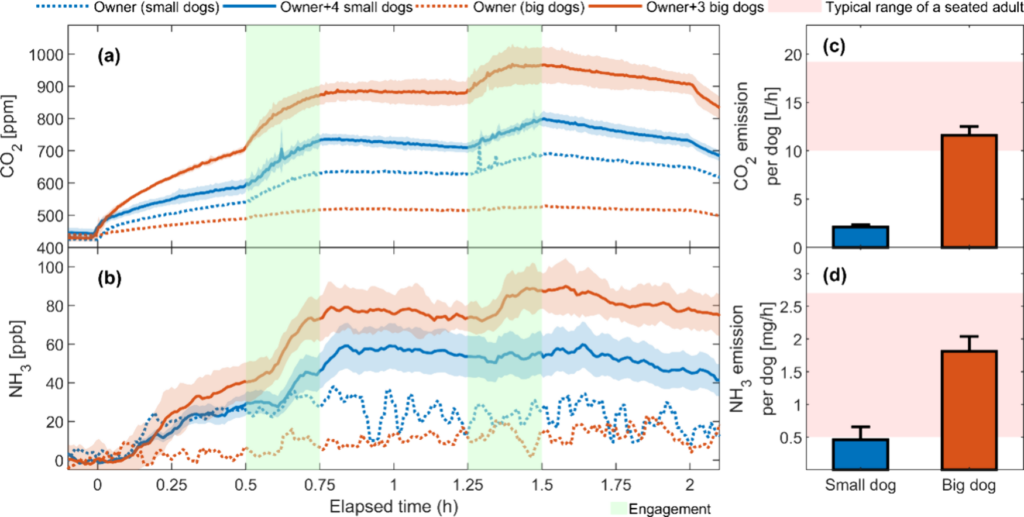
Carbon dioxide and ammonia are linked to physiological processes such as breathing and metabolism. Big dogs emitted more carbon dioxide, ammonia, fungi, and bacteria than small dogs. The large dogs emitted carbon dioxide at a rate similar to a seated adult, about 12 liters per hour, and emitted ammonia within the adult human range. Dogs also increased microbial richness and diversity in the chamber air. Some bacteria, such as Corynebacterium, were consistent with dog skin sources, while others, such as Psychrobacter, are more environmental and may have been transported into the chamber by the dogs. The dominant fungal types were also more environmental, suggesting that dogs may carry outdoor microbes indoors on their fur.
VOC measurements revealed increases in key ozonolysis products of squalene. VOCs are chemicals with high vapor pressure, meaning they easily enter the gas phase and can be found in air. Ozonolysis is a reaction where ozone adds to the carbon-carbon double bonds in molecules such as squalene. The VOC products detected included 6-methyl-5-hepten-2-one (6-MHO), nonanal, and acetone, which are smaller volatile molecules formed during this oxidation chemistry. Since dog skin oils do not contain much squalene, the squalene was likely transferred to dog fur during petting. Dogs may be more than emission sources: they can also act as reservoirs for chemicals from other indoor sources, keeping the chemistry going when oxidants, or reactive chemicals such as ozone, are present.
Compared with humans, dogs were not strong sources of nanocluster aerosols, even when ozone was present. However, they released substantial amounts of 1-10 micrometer particles, and their particle sizes differed from typical human emissions: dogs emitted a larger fraction of coarse particles above 5 micrometers. These particles may come from fur, skin, and dust resuspension; they can also be carried by dogs from outdoors.
Pets are often not considered in current indoor air quality research. Although the health implications are still unclear, this work highlights the overlooked role of dogs as indoor emission sources, carriers of outdoor and indoor pollutants, and participants in indoor air chemistry. With dogs living alongside millions of households, it is important to include them in indoor air quality assessment for the air humans and animals breathe together.
