Title: Identification of phosphatases that dephosphorylate the co-chaperone BAG3
Authors: Thomas Kokot, Johannes P. Zimmermann, Yamini Chand, Fabrice Krier, Lena Reimann, Laura Scheinost, Nico Höfflin, Alessandra Esch, Jörg Höhfeld, Bettina Warscheid, Maja Köhn
In: Life Science Alliance, 2024
Inside every cell, thousands of proteins are made every second. Each protein starts as a long chain of building blocks that must fold into a precise shape to work properly. You can think of this folding like a string twisting into a tool. When folded correctly, proteins send signals, carry out chemical reactions, or give the cell structure.
Sometimes a protein folds incorrectly. It can tangle or stick to other misfolded proteins, forming clumps that block normal cell functions. Cells have a cleanup system made of helper proteins. These helper proteins either refold damaged proteins or send them away for recycling.
One key coordinator is BAG3 (Bcl-2-associated athanogene 3), a protein that acts like the foreman of the cell’s recycling crew. BAG3 helps damaged proteins reach the cell’s disposal centers, where they are broken down and reused. When BAG3 or the cleanup system fails, misfolded proteins pile up like garbage in a city. Over time, this buildup is linked to diseases such as Alzheimer’s, Huntington’s, certain cancers, and some heart and muscle disorders.
Who Controls BAG3, the Foreman?
BAG3 needs clear instructions, such as when to start or stop working. These instructions come in the form of tiny chemical labels called phosphate tags, which are small groups made of phosphorus and oxygen atoms. Adding or removing a phosphate tag works like flipping a switch. It tells BAG3 where to go, which partners to connect with, and when to act.
Proteins called kinases add these tags, and proteins called phosphatases remove them. Scientists knew some kinases that act on BAG3, but the phosphatases, the “removers”, were unknown. If these phosphatases are absent or not functioning properly, BAG3 could get stuck in the wrong mode, disrupting the cell’s cleanup system.
Finding the Phosphatases That Control BAG3
Köhn and colleagues at the University of Freiburg and the University of Bonn studied human cells in the lab to find these phosphatases. They gave BAG3 a special tag so they could pull it out of the cell along with any proteins attached to it. Then they identified the captured proteins using mass spectrometry, a technique that breaks proteins into fragments and determines their identity from the precise mass of each fragment.
Two proteins stood out: protein phosphatase 1 (PP1) and protein phosphatase 5 (PP5). Both seemed to act directly on BAG3, suggesting they help control when it connects or disconnects from its cleanup partners.
PP1: The Switch Operator
PP1 removes a phosphate tag from a specific region of BAG3. In lab tests, adding PP1 caused this tag to disappear quickly, while in control samples without PP1, the tag remained (Figure 1A).
This tag controls BAG3’s interaction with another protein called 14-3-3γ, which helps guide clumped or damaged proteins to the right place for processing. When PP1 removes the tag, BAG3’s connection to 14-3-3γ weakens. Blocking PP1 keeps the tag in place and strengthens the connection (Figure 1B).
In simple terms, PP1 acts like a timing switch that tells BAG3 when to let go of its helper and move on to the next cleanup task.
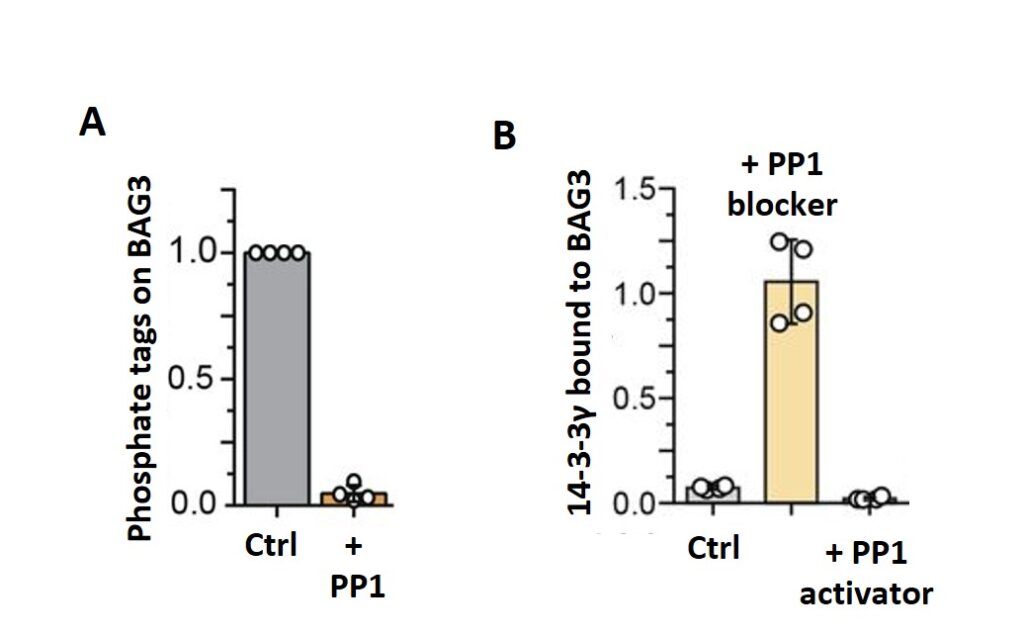
Figure 1. A: PP1 removes a phosphate tag from a specific region of BAG3. Researchers tested whether PP1 could remove this tag from BAG3. When PP1 was added, the level of the phosphate tag dropped sharply compared to the control (Ctrl), where no PP1 was added. B: PP1 activity controls BAG3’s connection with 14-3-3γ. In control cells, some BAG3 was bound to 14-3-3γ. Blocking PP1 led to more phosphate tagging of BAG3 and stronger binding to 14-3-3γ. Activating PP1 removed the tag and weakened the connection. In both figures, the y-axis depicts a relative number. Each dot is one experiment, and the bar shows the average and variation between experiments. Figure was taken from Köhn et al., 2024, under a Creative Commons License (Attribution 4.0 International, https://creativecommons.org/licenses/by/4.0/) and adapted by Corina Maller for easier understanding.
PP5: The Crew Coordinator
While PP1 works on one specific site, PP5 targets a different region of BAG3, where several phosphate tags can be added or removed. This region helps BAG3 form partnerships with other proteins that handle damaged material. The researchers found that when PP5 removed phosphate tags from this region, BAG3 could bind more strongly to a helper protein called HspB8 (Figure 2A). HspB8 helps BAG3 recognize and break down damaged proteins. Removing the tags did not change BAG3’s connection to 14-3-3γ, which shows that PP5 works in a different part of the protein from PP1 (Figure 2B).
In simple terms, PP5 makes sure BAG3 teams up properly with its cleanup crew, while PP1 helps control when BAG3 should let go of its cargo. Together, these two proteins keep the cell’s protein cleanup system running smoothly.
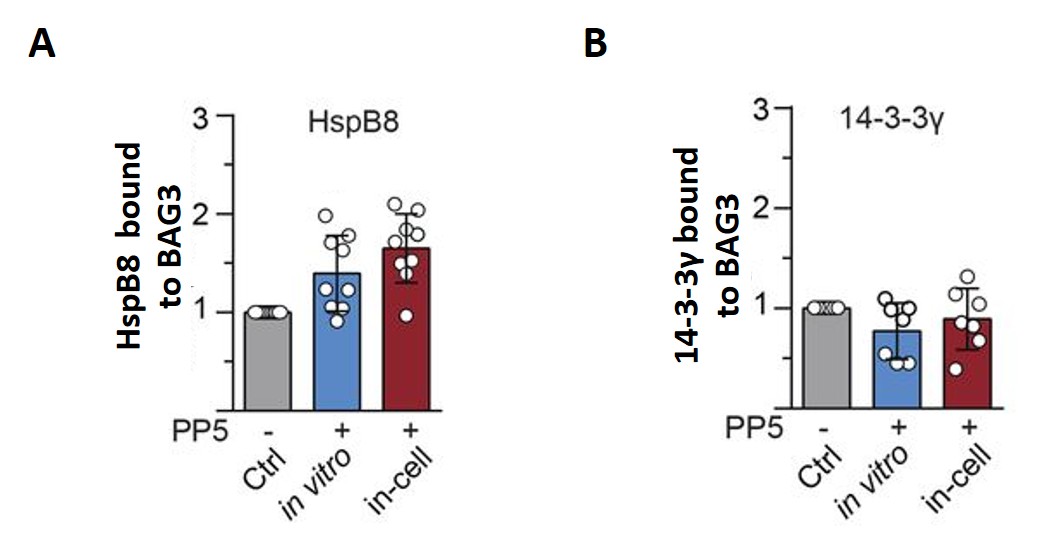
Figure 2. A: PP5 increases how much HspB8 binds to BAG3. Researchers tested BAG3 in three conditions: control (Ctrl, no PP5), adding PP5 to BAG3 in a test tube (in vitro), and PP5 together with BAG3 inside human cells (in-cell). More HspB8 was attached to BAG3 when PP5 was present compared to the control. B: PP5 does not change how much 14-3-3γ binds to BAG3. Using the same three conditions, the amount of 14-3-3γ attached to BAG3 stayed about the same in all three cases. In both figures, the y-axis shows the relative amount of protein bound to BAG3 compared to the control. Each dot is one experiment, and the bar shows the average and variation between experiments. Figure was taken from Köhn et al., 2024, under a Creative Commons License (Attribution 4.0 International, https://creativecommons.org/licenses/by/4.0/) and adapted by Corina Maller for easier understanding.
Key Takeaway
BAG3 acts as the foreman of the cell’s protein cleanup crew. It works with different partners to keep the system running smoothly. HspB8 helps BAG3 recognize and grab damaged proteins, and PP5 makes sure BAG3 binds tightly to HspB8. 14-3-3γ helps BAG3 move clumped proteins to the right place, and PP1 tells BAG3 when to let go of 14-3-3γ and move on to the next task. Together, PP1 and PP5 fine-tune BAG3’s work, keeping the cell free of harmful protein clumps.
Discovering More of BAG3’s Network
Köhn and colleagues have added an important piece to the puzzle, showing how our cells manage damaged proteins. While PP1 and PP5 are key players, BAG3 has many interaction sites, suggesting that other phosphatases, kinases, or regulators may also be involved. Studying these proteins will not only help us understand how BAG3 works but could reveal new ways to prevent the buildup of damaged proteins that can contribute to disease.

