
Authors: Julia Czopinska, Filip Budny, Andrzej Peplowski, Anna Sobiepanek, and Marta Jarczewska.
Journal: Bioelectrochemistry
Year Published: 2025
Cover Image Credit: Saulhm, wikicommons
For many of us, most injuries are minor and heal quickly. First you get a cut and then there’s some heat and swelling before the wound slowly heals. But for some wounds, particularly in people with medical conditions that effect wound healing, this process can get stalled and the injury does not heal. One biomarker involved in this is called tumor Necrosis Factor-alpha or TNF-α. This protein helps get cells to the injury at the start of the healing process, but if it is produced for too long, can indicate a injury has gotten stuck and isn’t healing properly.
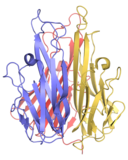
Figure 1: The TNF- α protein is important for early stages of wound healing, but can pose problems if it remains for too long. Source: Wikicommons, user Synpath
Researchers in Warsaw university Poland recently set out to measure the presence of TNF- α. To do this they used a type of sensor called a aptasensor. A aptasensor is a small piece of specially shaped DNA that is able to connect with the TNF- α like a key in a lock. When this happens, a tiny electrical signal is produced. In most sensors, gold is used as a base to carry this signal to the instrument that reads it, but gold is expensive and can pick up electrical signals from things other than TNF- α. In this paper, the researchers instead used a conductive molecule made from carbon and hydrogen atoms.
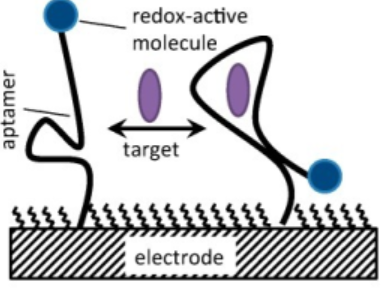
Figure 2: Aptasensors are strands of specially designed DNA (black) that change shape when interating with a specific target (purple)
To test the sensor, researchers first tested it when in contact with real skin cells to make sure the new carbon and hydrogen base was not dangerous to human skin. No toxicity was observed. Then they tested its ability to actually measure TNF-α. First they used water with some TNF-α added and the sensor performed well. However, it is more complicated to measure TNF-α in real blood because there are other molecules that may be similar and confuse the sensor. To make sure the sensor worked in a real-life context, they tested the ability to measure TNF-α in liquid that would be found in an open wound and it was able to make the measurement accurately.
Right now, measuring the concentration of TNF-α can take days and professional lab equipment and measurements that are not universally available. While this technology is still a long way from being commercially viable, the future of wound care may involve rapid measurements using a skin patch to let patients and doctors when a wound is not healing and needs further treatment.


