
Title: Oxidative potential of atmospheric particles in Europe and exposure scenarios
Authors: Cécile Tassel, Jean-Luc Jaffrezo, Pamela Dominutti, Kaspar R. Daellenbach, Sophie Darfeuil, Rhabira Elazzouzi, Paolo Laj, Anouk Marsal, Takoua Mhadhbi, Vy Ngoc Thuy Dinh, Céline Voiron, Stephan Houdier, Marc Durif, Mélodie Chatain, Florie Francony, Julie Cozic, Guillaume Salque Moreton, Meryll Le Quilleuc, Véronique Ghersi, Grégory Gille, Boualem Mesbah, Evdokia Stratigou, Manuela Zublena, Henri Diémoz, Andrés Alastuey, Barbara D’Anna, Nicolas Marchand, Sébastien Conil, Valérie Gros, Marloes F. van Os, Imre Salma, Nikolaos Mihalopoulos, Griša Močnik, Katja Džepina, Katarzyna Styszko, Christoph Hüglin, Xavier Querol, André S. H. Prévôt, Olivier Favez, Valérie Siroux, Gaëlle Uzu
Journal: Nature
Year: 2025
Produced by a wide range of natural and human sources, from sea spray to residential wood burning, particulate matter (PM) is an important class of air pollutant which results in a host of negative health impacts for humans around the world. The minuscule particles produced by these sources are generally categorised based on particle diameter as less than 10 μm (PM10) and less than 2.5 μm (PM2.5) and they can find their way deep into our lungs with every breath we take. It is for this reason that governments have a long history of attempting to keep the atmospheric concentrations of PM10 and PM2.5 below defined limits designed to protect public health. However, the chemical composition of PM is as diverse as its emission sources and the health outcomes of exposure to different types of PM can vary wildly. Current mass-based PM concentration guidelines omit this complexity due to the difficulty of measuring particle composition and of measuring the health outcomes of all PM types. This means that under current legislation, 1 unit of PM is treated the same, regardless of whether it came from residential burning, vehicle emissions, or construction dust.
Oxidative potential (OP) is one means by which to try to quantify the difference between different types of PM. OP is a measure of the ability of PM to induce the formation of reactive oxygen species in biological substances, which are a key component in inflammatory responses. In a recent paper published in Nature, Tassel and coworkers outline the results from measurements of OP in 11500 samples collected across 43 locations in Europe. Using this dataset, they demonstrate how the use of OP as a metric for assessing exposure to PM could change the way policy-makers target different PM sources in light of differential health outcomes.
At each measurement location, PM was collected onto filters, which could be weighed before and after the collection period to determine the concentration of PM in the air. However, Tassel et al. took a small sample of each filter for chemical analysis. The researchers dissolved the PM from the filter sample into a fluid designed to mimic the fluid found in human lungs and then added different reference compounds to the solution. Over time, the reactive oxygen species formed by the presence of the PM react with the reference compound and cause its concentration to decay. By measuring this decay, the researchers quantified the OP of each PM sample. This method provides a way to gain insight into the impact of the chemical composition of each PM sample on OP, rather than only measuring the PM concentration.
By analysing the PM sources contributing most at each measurement location, the researchers were able to identify which sources produced PM with higher OP. For example, they found that traffic-related sources have a large impact on OP, whereas biomass burning plays a larger role in PM10 mass metrics. This has important policy implications for determining which sources may be targeted in different regions if OP were adopted as an air quality metric alongside PM mass. Although the infancy of the OP metric for assessing PM health effects means that there is no established guidance for “acceptable” OP levels, the researchers noted that 74% of urban sites and 92% of traffic-impacted sites reached OP values similar to those observed in the less polluted urban sites. This is compared to 44% of urban sites and 58% of traffic sites that breached current annual PM10 mass thresholds.
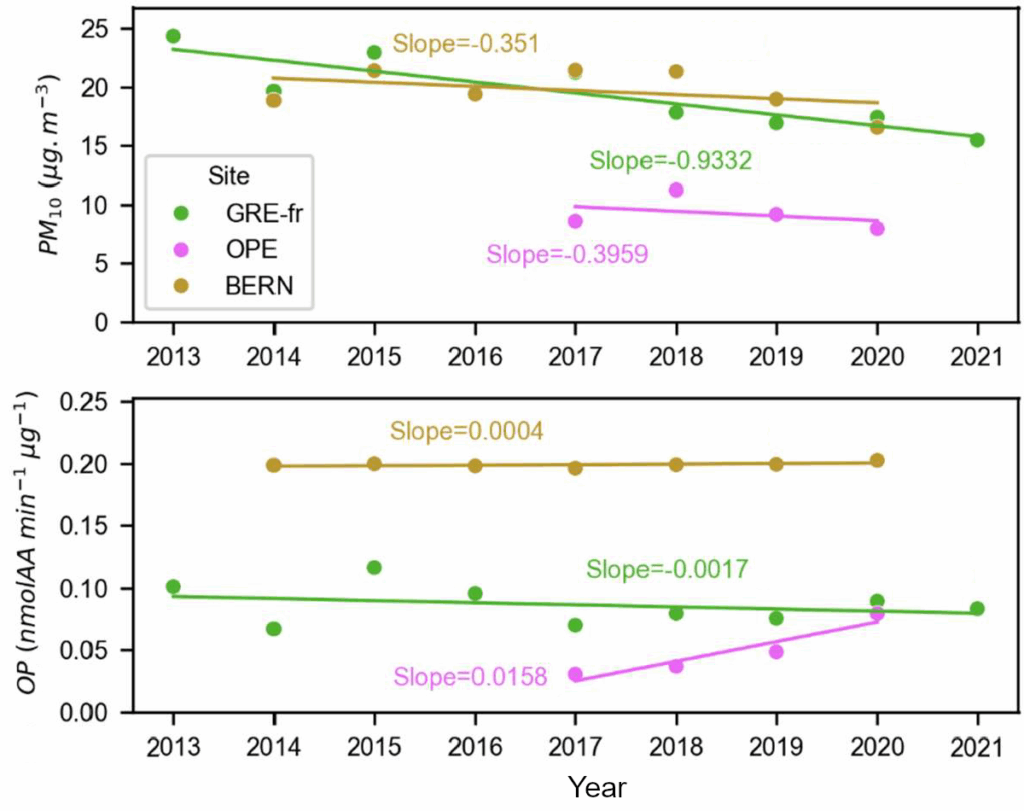
In this work, the researchers made use of samples collected as far back as 2012, meaning they were able to assess the changes in OP over time (Figure 1). In conducting this analysis, the researchers found that despite sustained reductions in PM10 mass over the past decade, as indicated by negative gradients in the upper panel of Figure 1, the OP metrics in the lower panel often showed little change, and even showed increases in some regions. Again, this is important information for policymakers who may overlook the potential negative health impacts of higher-OP PM when only assessing air quality in terms of PM mass.
Throughout the paper, the researchers note that OP as a metric for PM health effects is still in its infancy, and that further measurements of PM OP in different environments, along with large-scale epidemiological studies can provide the information needed in the future to set OP standards that can be incorporated into policy. However, this work offers a clear demonstration of the unique insight that can be gained by considering more than just concentration when measuring PM in the atmosphere.
Featured image by Alexey Demidov on Pexels.

