
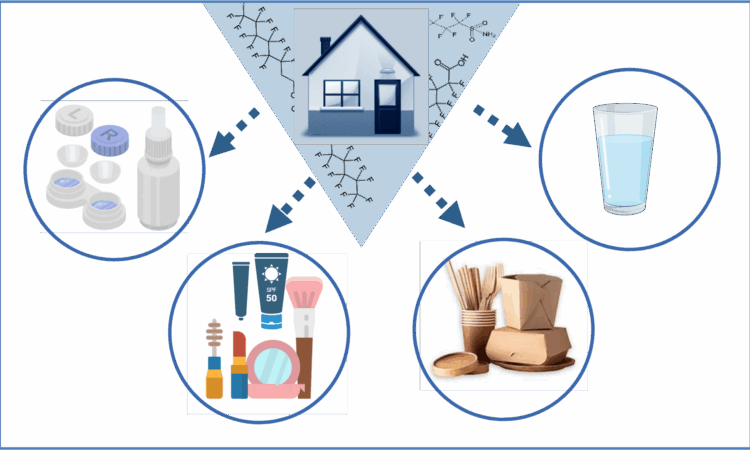
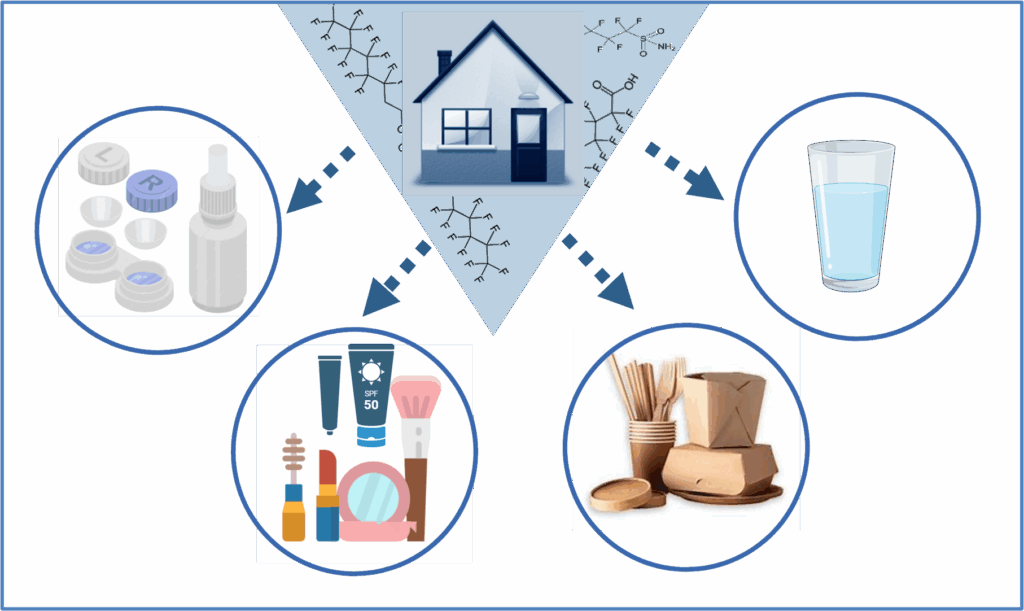
You might expect industrial chemicals to show up in factories or fire fighting gear, but not in your mascara, contact lenses or even your toothpaste! Behind convenience and performance of these personal care products, many of them may contain PFAS. PFAS or per- and polyfluoroalkyl substances are a group of highly persistent chemicals often called forever chemicals. These compounds are used to make products more durable, water-resistant, or long-lasting, PFAS are increasingly found in cosmetics, dental products, and even medical-grade materials. Their presence in such intimate items raises growing concerns about invisible, everyday exposure.
Where are PFAS hiding?
PFAS are widely used in:
- Cosmetics like waterproof mascara and long-lasting lipstick
- Non-stick cookware and food packaging
- Water-resistant textiles
- Contact lenses
A 2023 investigation by Mamavation and Environmental Health News revealed PFAS in all 18 tested contact lens brands—some with over 100,000 ppm organic fluorine. These levels suggest that millions of users could be exposed through their eyes daily (Kang et al., 2024).
PFAS in packaging?
A 2024 study by Marchiandi et al. screened 162 non-alcoholic beverages sold in Australia and found endocrine-disrupting chemicals—including PFAS—in multiple samples. PFAS were most frequently found in metal-packaged drinks. Though concentrations were low, frequent consumption of such beverages may contribute to chronic low-level PFAS exposure (Marchiandi et al., 2024).
PFAS in food: More than just fish
PFAS aren’t limited to packaging—they’re also present in our food. In a study across four European countries, D’Hollander et al. (2015) found PFAS in 67% of food items, with the highest concentrations in fruits like apples and pears. This shows how PFAS can enter the food chain through irrigation, air deposition, or contact with contaminated materials (D’Hollander et al., 2015).
A global view: What we know (and don’t know) about PFAS
In a 2024 review, Habib et al. summarized the risks of both short- and long-chain PFAS, emphasizing how short-chain variants—once thought safer—are more mobile and harder to remove from water. The review also highlights how current regulations fall short, especially for newer PFAS that remain poorly studied (Habib et al., 2024).
Mapping PFAS: Where do they come from, and how do they reach us?
PFAS are released during manufacturing and incorporated into consumer products. From there, they enter indoor air and dust, leach from landfills, and pass-through wastewater treatment plants reaching biosolids, agricultural land, surface and groundwater, and eventually the food chain and drinking water. Humans are exposed via inhalation, ingestion, and skin contact, and PFAS have been detected in blood and breast milk.
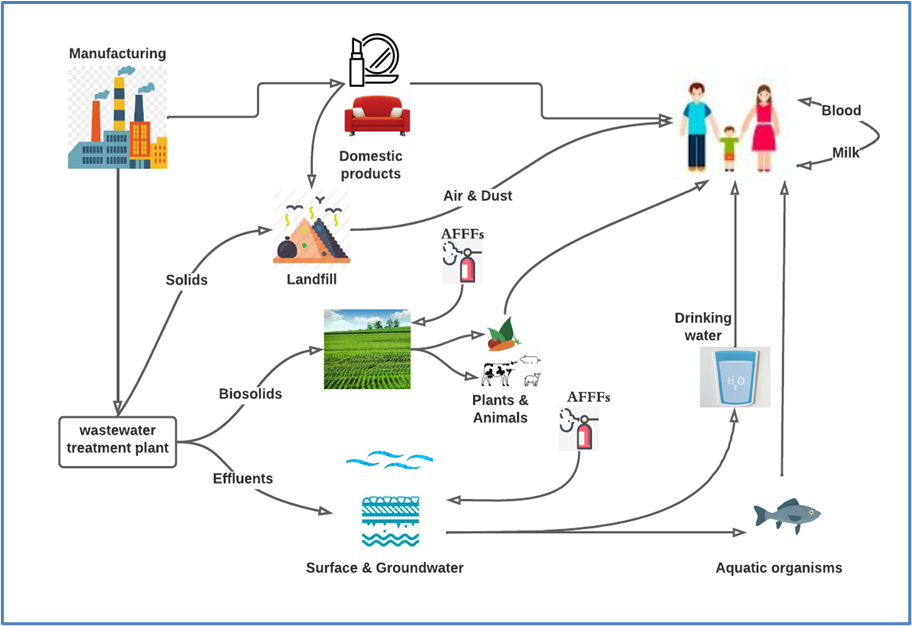
Key exposure sources in the image:
- Manufacturing: Source of PFAS used in domestic and industrial products.
- Domestic products: Leach PFAS into indoor environments (air, dust).
- Landfills: Release PFAS through leachate and gases.
- Wastewater treatment plants: Cannot fully remove PFAS; pass them into effluents and biosolids.
- Agriculture: PFAS-contaminated biosolids and water affect crops and livestock.
- AFFF firefighting foams: Highly contaminated hotspots around airports and defense sites.
- Drinking water & food chain: Final exposure routes to humans and wildlife.
This network of environmental pathways explains why PFAS exposure is widespread, persistent, and difficult to eliminate without systemic upstream changes
Why they are so hard to detect?
Measuring PFAS requires:
- – LC-MS/MS (liquid chromatography–tandem mass spectrometry), an instrument with high sensitivity and selectivity capable of detecting PFAS analytes at extremely low levels, often in the range of parts per quadrillion (ppq) to parts per trillion (ppt).
- – Complex extraction methods, which vary depending on the sample matrix and targeted PFAS analytes. No single method is universally effective for the entire range of PFAS compounds. Common techniques include these solid-phase extraction (SPE), liquid-liquid extraction (LLE), and QuEChERS (Quick, Easy, Cheap, Effective, Rugged and Safe).
- – Stringent lab controls, as PFAS are widespread environmental contaminants and can easily be introduced form labware, solvents, or airborne dust. Preventing contamination requires the use of PFAS- free materials, carful cleaning procedures, and routine inclusion of field and procedural blanks.
Can we get rid of them?
Filtering PFAS is possible—but destroying them is harder. Current methods are still in development and not widely available yet. These methods include:
- – Plasma treatment
- – UV oxidation
- – Electrochemical degradation
So, why should we care?
PFAS are no longer just industrial chemicals, they’re in our homes, bodies, and ecosystems. They’ve been linked to immune dysfunction, reproductive problems, and cancer. Yet many remain unregulated and unlabelled. Understanding where PFAS hides how to detect and eliminate them is critical for safer products and stronger policies.
References:
D’Hollander, W., Herzke, D., Huber, S., Hajslova, J., Pulkrabova, J., Brambilla, G., De Filippis, S.P., Bervoets, L. & de Voogt, P. (2015) Occurrence of perfluorinated alkylated substances in cereals, salt, sweets and fruit items collected in four European countries. Chemosphere, 129, 179-185.
Habib, Z., Song, M., Ikram, S. & Zahra, Z. (2024) Overview of Per- and Polyfluoroalkyl Substances (PFAS), Their Applications, Sources, and Potential Impacts on Human Health. Pollutants, 4, 136-152.
Kang, H., Kim, D.H. & Choi, Y.-H. (2024) Elevated levels of serum per- and poly-fluoroalkyl substances (PFAS) in contact lens users of U.S. young adults. Chemosphere, 350, 141134.
Marchiandi, J., Alghamdi, W., Dagnino, S., Green, M.P. & Clarke, B.O. (2024) Exposure to endocrine disrupting chemicals from beverage packaging materials and risk assessment for consumers. Journal of Hazardous Materials, 465, 133314.

