
Title: Human gut microbial aromatic amino acid and related metabolites prevent obesity through intestinal immune control
Authors: Zengliang Jiang, Liuqing He, Diyin Li, Laibao Zhuo, Lingjun Chen, Rui-Qi Shi, Jianhua Luo, Yuhui Feng, Yuhui Liang, Danyang Li, Xiao Congmei, Yuanqing Fu, Yu-ming Chen, Ju-Sheng Zheng, Liang Tao
In: Nature Metabolism, 2025
Obesity and its related diseases are among the biggest health challenges of our time. But what if some of the tools to fight it are already inside us, specifically in our gut?
Our digestive tract is home to trillions of microbes, collectively called the gut microbiome. These tiny organisms do more than help digest food and produce vitamins. They can affect metabolism, influence energy use, and even determine how much fat our bodies store.
Knowing that microbes matter is one thing. Figuring out the details — which microbes are involved, what molecules they produce, and how those molecules influence us — is another. A recent study in Nature Metabolism takes a closer look and identifies one such molecule: 4-hydroxyphenylacetic acid (4HPAA, Figure 1a). This byproduct of microbial metabolism helped prevent weight gain in mice fed a high-fat diet (HFD).
To understand how 4HPAA is formed, it helps to look at how gut microbes process our food. They break down proteins into smaller pieces called amino acids, which they use for energy. Some amino acids, such as phenylalanine and tyrosine (Figure 1a), contain ring-shaped carbon structures (highlighted in orange in Figure 1a) that also appear in 4HPAA. When microbes metabolize these “aromatic” amino acids in a process called aromatic amino acid metabolism, they generate compounds like 4HPAA as byproducts (Figure 1a).
For the microbes, 4HPAA is waste. For us, it may be much more.
When researchers gave 4HPAA to mice on a HFD, the animals gained about 45% less weight than those who did not receive it (Figure 1b). They also had less body fat (Figure 1c), smaller fat cells, and healthier liver function.
Both figures use box-and-whisker plots, where each dot is a mouse and the boxes show how spread out the data is. Red boxes are 4HPAA-treated mice, blue boxes are untreated. On the left are normal-diet (ND) mice, and on the right are those fed a HFD. Researchers use p-values to check if differences within an experiment are meaningful. Here, a low p-value shows the reduction in weight and body fat is highly significant, while a high p-value means there’s no real difference between treated and untreated mice.
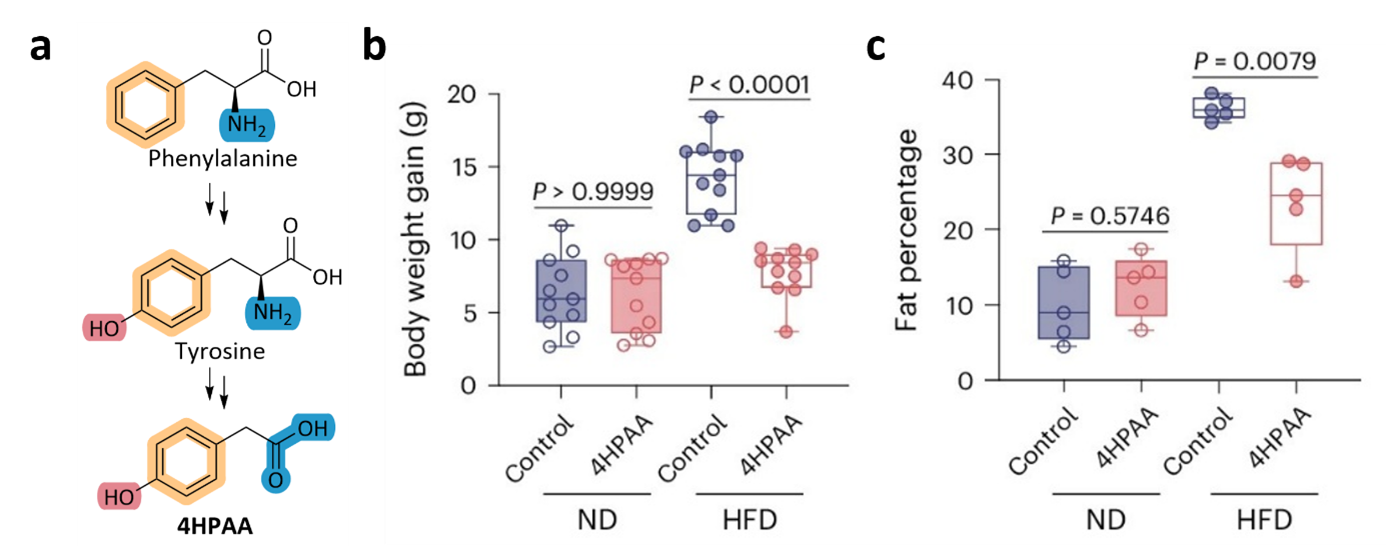
Figure 1: 4-Hydroxyphenylacetic acid (4HPAA) limits weight gain in mice on a high-fat diet (HFD). a: Chemical structures of the aromatic amino acids phenylalanine and tyrosine, and their microbial breakdown product 4HPAA. The shared ring structure is highlighted in orange, and the parts that differ are marked in red and blue. b: Weight gain of mice on a normal diet (ND) or high-fat diet, with or without 4HPAA treatment. c: Body fat percentage in ND and HFD mice, showing how 4HPAA reduces fat accumulation. Subfigure a created by Corina Maller. Subfigures b and c reprinted from Nature Metabolism under a CC BY-NC-ND 4.0 license.
Interestingly, the benefits didn’t come from eating less or burning more energy. Instead, 4HPAA seemed to act in the gut, where it reduced the uptake of nutrients into the bloodstream. With less material available to store as fat, the mice gained less weight and accumulated fewer fat deposits over time.
The effects went beyond nutrient absorption. The researchers also found that 4HPAA influenced the gut’s immune system. It acted on specific immune cells that help protect the intestinal lining, a barrier between the gut and the rest of the body. By strengthening this barrier and reducing inflammation, 4HPAA supported a healthier gut environment — important because chronic gut inflammation is linked to obesity and other metabolic diseases.
After observing these results in mice, the researchers asked whether similar effects could be found in people. In a long-term health study in China involving more than 800 participants, they observed that individuals with higher levels of 4HPAA in their blood tended to have less body fat and healthier cholesterol levels.
Seeing the effects on weight and gut health, the team’s next step was to figure out which microbes make 4HPAA.
They identified a bacterium called Clostridium argentinense. When given to mice, the 4HPAA it produced helped reduce weight gain (Figure 2).
The figure uses violin plots, where each dot is a mouse and the shape of the plot shows how much the results varied within the group. For C. argentinense, the plot is tight because the mice gained consistently less weight, while the other bacteria show broader shapes and more variation. Again, the researchers used p-values to confirm that these differences were meaningful, highlighting the unique effect of C. argentinense and the role of 4HPAA in controlling body fat.
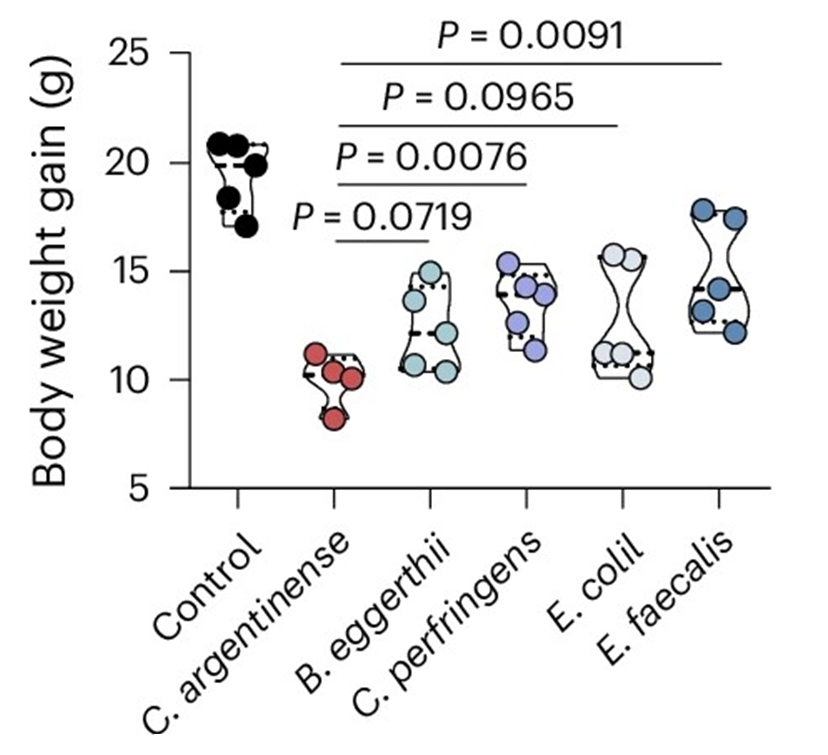
Figure 2: Weight gain in mice given different bacteria every 3 days for 8 weeks. The plots show how much weight the mice gained after receiving the bacteria listed on the x-axis. Figure adapted and reprinted from Nature Metabolism under a CC BY-NC-ND 4.0 license
Taken together, these findings show how microbial byproducts — even those microbes treat as waste — can shape our metabolism and health. 4HPAA provides one example of how the gut microbiome influences fat storage, nutrient use, and immune balance.
Of course, this does not mean there is a quick fix for obesity or that we can skip healthy habits. There is still no “magic pill.” But insights like these point toward new strategies for prevention and treatment, from probiotics and personalized diets to therapies designed around each person’s unique microbiome.
The microbes in our gut might be tiny, but their impact is big.

