
Title: Elution revolution: Reversing chiral recognition by swapping D- for L-cellulose
Authors: Anna F. Lehrhofer, Markus Bacher, Ivan Melikhov, Irina Sulaeva, Wolfgang Lindner, Michal Kohout, Hiroshi Kamitakahara, Antje Potthast, Thomas Rosenau, Hubert Hettegger
In: Carbohydrate Polymers, 2025
Have you ever accidentally tried to put a right-handed glove on your left hand? Even though the two gloves look identical at first glance, you can’t put the right-handed glove on your left hand.
This simple concept, where an object and its mirror image are not interchangeable or not superimposable (Figure 1), is what scientists call chirality.
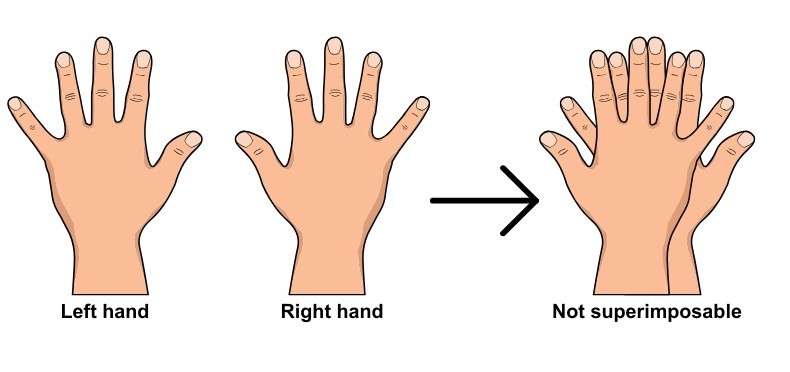
Figure 1: The Concept of Handedness (Chirality). Some objects, like your hands, are chiral. If you hold your left hand up to a mirror, it looks exactly like your right hand (your left hand is a mirror image of your right hand). As shown on the right side of the figure, even though they look the same, you cannot slide one perfectly on top of the other so that all the fingers and thumbs line up, meaning they are not superimposable.
You can see this handedness everywhere in nature. If you look at climbing plants like honeysuckle or bindweed, they always spiral around a support in one specific direction.
Cellulose is another example. It is the material that gives plants and trees their strength. In nature, it only exists in a right-handed form called D-cellulose, and Anna F. Lehrhofer and her team from BOKU University in Vienna wanted to change that.
Why Handedness Matters in Life
Most biological molecules exist in two forms, called enantiomers, which are mirror images of each other. In nature, however, things are rarely equal. Our bodies almost exclusively use right-handed sugars (D-sugars) and left-handed amino acids (L-amino acids). A right-handed drug might cure a disease, while its left-handed mirror image might be completely ineffective or even toxic.
This is why chemists need reliable ways to distinguish between these mirror images after synthesis. Usually, they use tools made from natural materials, such as cellulose, to separate these pairs via High-Performance Liquid Chromatography (HPLC):
In this process, cellulose is turned into a material called a chiral stationary phase. This material acts like a specialised filter inside a column. As a mixture of mirror-image molecules passes through the column, they interact differently with the cellulose.
Because the cellulose itself has a specific handedness, it forms temporary complexes with the target molecules. One mirror image will naturally fit better into the cellulose’s “binding pockets” than the other. The molecule that fits better gets stuck for longer and moves more slowly, while the other version passes through more quickly. This difference in speed allows chemists to collect the two versions separately as they exit the column.
Building the Mirror Image: Creating L-Cellulose
Cellulose is a long chain of sugar molecules. In nature, these chains are always made of D-glucose.To bypass this natural restriction, Anna F. Lehrhofer and her team had to build their own version from scratch.
- Synthesising L-Cellulose: The team used chemical reactions to link together left-handed sugar building blocks. This allowed them to create the mirror-image, L-cellulose.
- The Length Challenge: They discovered that the length of these sugar chains was a critical factor. If the chains were too short, the material could not form the stable structures needed to work as a filter. They found that for the material to be effective, the chains had to be at least 18 units long.
- Coating the Columns: Once they had these mirror-image chains, they coated the L-cellulose onto tiny silica beads and packed them into a column used for HPLC.
Understanding the Labels: D, L, R, and S
Before we continue with the results of testing their columns, we need to look at how scientists label handedness. When chemists talk about this concept, they use two different naming systems to describe how molecules are built and how they behave.
- D and L: These labels are often used for sugars and amino acids based on their overall structure. In nature, almost all cellulose is made of D-glucose (right-handed), while the team synthesised the mirror-image L-cellulose from L-glucose (left-handed) (Figure 2).
- R and S: These letters describe the specific 3D arrangement of atoms around a single centre. R (from the Latin Rectus) stands for right, and S (from the Latin Sinister) stands for left. Think of these as the coordinates that tell you exactly which way a specific part of a molecule is pointing.
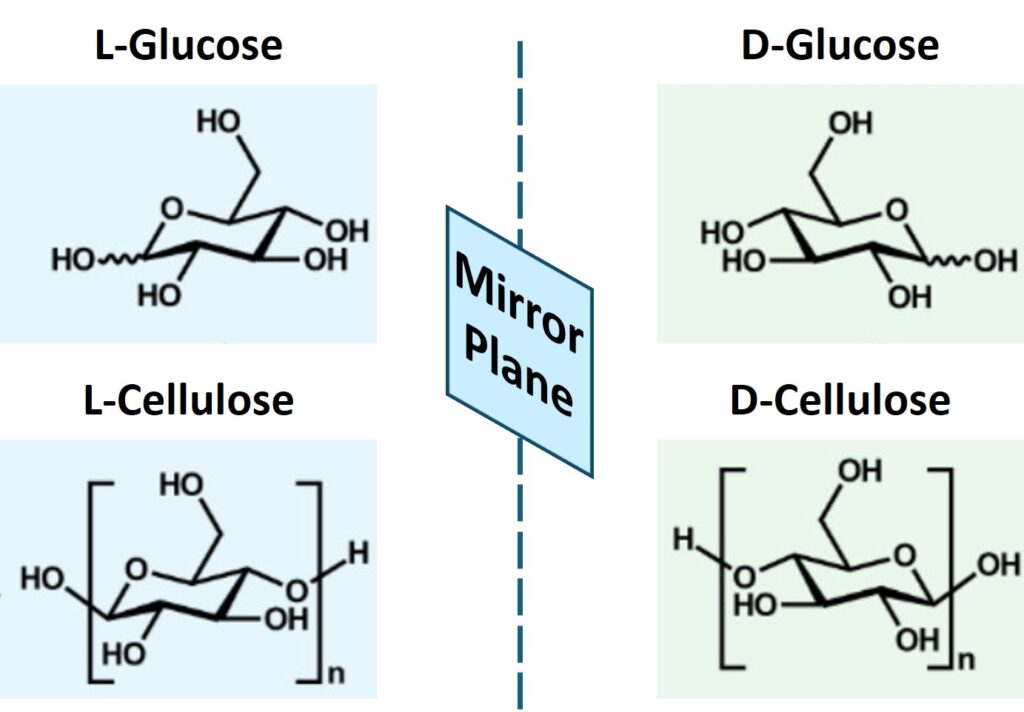
Figure 2: Structure of L-Glucose, L-Cellulose, D-Glucose, and D-Cellulose. L-forms and D-forms are divided by a mirror plane, showing that they are mirror images of one another. Structures were taken from Lehrhofer et al. (2025) under a Creative Commons Licence (Attribution 4.0 International) and figure created by Corina Maller.
- Top Row: Individual sugar units (monomers). On the left is the synthetic L-glucose, and on the right is naturally occurring D-glucose. These are mirror images of one another and are therefore enantiomers. As shown, they have the same shape but cannot be superimposed on one another.
- Bottom Row: Molecules after polymerisation (the process of linking sugars into long chains). This is shown by the brackets and the letter n, which is a placeholder in chemistry indicating that there is an “n” number of molecules linked to each other. On the bottom left is L-cellulose, the new, left-handed synthetic material. On the bottom right is D-cellulose, the natural, right-handed material that provides structure to plants.
The Elution Revolution
Once the columns were ready, the researchers put them to the test. They ran various mixtures of chiral molecules, right-handed (R) and left-handed (S), through both the traditional D-cellulose columns and their new L-cellulose versions to see how they compared. What they found was a total inversion of the results.
This swap in the order the chiral molecules exit the column is called the elution order. Figure 3 shows how this order reverses between the two versions.
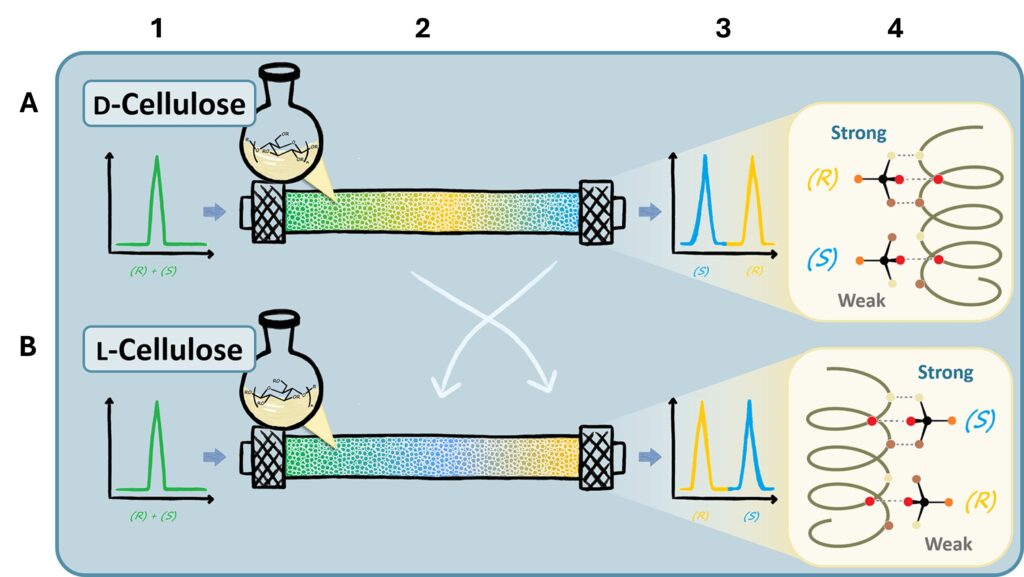
Figure 3: Visualising the Elution Revolution. This figure was taken from Lehrhofer et al. (2025) under a Creative Commons Licence (Attribution 4.0 International) and labelled by Corina Maller for easier understanding. The details of the experiment are outlined in the main text below.
A: Experiment with natural D-cellulose and B: Experiment with synthetic L-cellulose.
- The Starting Mixture (1): The process begins with a single green peak on a chromatogram (a visual chart used to track chemicals as they pass through a filter). This peak represents a racemic mixture, which is a 50/50 blend of right-handed (R) molecules (yellow) and left-handed (S) molecules (blue). At this stage, they are mixed so that they are indistinguishable from each other.
- Inside the Column (2): The mixture enters a column packed with either D- or L-cellulose. As shown in the round-bottom flasks, these two materials look nearly identical, but their molecular handedness is mirrored. As the mixture travels to the right, the green colour splits. This shows the molecules being separated based on how tightly they interact with either the D- or L-cellulose.
- The Elution Order (3): At the exit, the chart shows two distinct peaks because the molecules have been separated. However, the order is flipped between the two experiments. In the D-cellulose column, the blue (S) molecule exits first. In the L-cellulose column, the yellow (R) molecule exits first.
- The Key-Lock Interaction (4): This reversed behaviour is caused by the strength of the interaction between the molecules and the cellulose. The cellulose is represented by the coils, and the molecules are shown as atom clusters (the coloured circles):
- In the D-column, the (R) molecule has a strong connection to the right-handed coil, causing it to get stuck and exit second.
- In the L-column, the (S) molecule has a strong connection, while the (R) molecule has a weak connection and exits first.
Takeaway
Through this study, Anna F. Lehrhofer and her colleagues successfully synthesised L-cellulose from L-glucose, the exact mirror-image of naturally occurring D-cellulose. By using this synthetic version in HPLC, the team demonstrated that the elution order of chiral molecules could be completely reversed simply by swapping the stationary phase from the natural D-form to the new L-form.
By rebuilding one of nature’s most basic materials in reverse, Lehrhofer and her colleagues have shown that we are not restricted to using only the handedness nature provides.

